Monday, 7 March 2011

WORLD IN THE WASTELANDS OF YUMA---PART TWO

ESCAPE TO THE HINTERLANDS----THE FRINGES OF SOCIETY---A NEAR UNIVERSAL HUNGER---Or fantasy. The Hero in many movies---runs to the wild lands for solice, healing, inspiration ---where he meets strange characters living interesting lives. (e.g. Blade Runner) The experience is transformative and he returns stronger and wiser for the experience. Yuma has more wild lands---wastelands--than most cities. I will take you there and let you meet some of its inhabitants. I begin here---In the parking lot of the Paradise Casino beside the Colorado River---pointed west with solar panels raised to collect more solar energy. All those folks are camping free--and each, to some degree, a maverick--- refusing to pay campground fees.
Sunset finds me in this historic spot---Yuma Crossing. The first bridge is the Railroad---the second is the famous "Ocean to Ocean" highway bridge completing the transcontinental roadway. The third bridge is Interstate Highway Eight.
Glancing left I see the watchtower of historic Yuma Territorial Prison. I will go there to photograph some wastelands.
I walk across the bridge next day--pay the $5 fee.
Tour the prison (again) ---and from that tower show the much -diminished Colorado River that is allowed to flow into Mexico. The vast majority--perhaps 80%---has been diverted 20 miles upstream into the All American Canal.
Now I turn to the North to show you some of the Wastelands I mean to explore---the floodplain of the river. People live out there in those bushes.
But first I will follow the course of the remaining 80% of the river---the All American Canal---flowing generally West into California . Here, it meanders under Interstate 8 in the distance.
I turn around 180 degrees to show more wastelands---with some outlanders camped there.
Further downstream---a crucial juncture that changed history---for this is the spot where---in 1905--an overfull--rainswollen--rampaging Colorado River--broke through all obstacles----carving a brand-new river---FLOWING NORTH---into a dry lake bed--thus creating the Salton Sea. That channel on the left--leading into Mexico-- is now blocked and all the water--channeled---ON THE AMERICAN SIDE---to the farmlands of the Imperial Valley---40 miles West.
Enormous effort and money were expended to assure American control of this water. The new canal had to be routed through those mountains--AND THEN--through 5 miles of gigantic sand dunes! I'll show you. But the relevance for this blog is that this project created miles and miles of wastelands where outlanders and solace-seekers may live---for a day---or a year. Look carefully and you will see campers like me on the edge and atop the spoil bank. I'll follow this road to it's abrupt end.
A tiny---but interesting--outlander rig---surely there's a story here---I'll come back and see who's living there.
The canal curves toward a niche in the mountains. That structure on the right is a watershed overpass--to prevent local drainage from entering the canal.
And there's where the canal builders blasted a route through the mountain--and where the road ends. I've been told that 10% of all the vegetables grown in the US are nurtured with this water.
Now---back to my story--I park and climb the spoil bank. Down there are the wild lands---the waste lands---Can you see "my people" camped here and there in the bushes. In the distance you can see a few hundred campers clustered at the Q casino. They park there for $5 a night to give them easy access to the nearby Mexican city of Algodones. (cheap dental work and medicines)---I'm going down into those bushes for a close look. Also---I know that a dear friend is buried down there in a sandy grave---I will go pay my respects----and continue my wastelands report tomorrow with the people I meet.
I leave you with this shot of the canal passing through the great Imperial dunes---They are awesome and I love them. Notice the concrete lining---to prevent seepage loss.
RANDY PHILOSOPHIZES: I'm drawn to the wastelands and I bet you are too. That is where order ends and surprise is likely----the demarcation line where the rich, the greedy and status seekers lose interest --- drop away. Here is no grist for their mill. Historically, wastelands are sanctuary for the persecuted---the weaker groups. The Paiute Indians were pushed by more powerful tribes to desert wastelands like Nevada. The Seminoles to the swamps of Florida. And (karmically?) they were in turn pushed to the wastelands by us. Almost all reservations are wastelands where defeated races sulk to this day. (Indian bitterness will begin to heal the day they admit they are as bad as we are) Incidentally, I'm waiting for an opportnity to ask a nature-loving Indian why their reservations are so universally littered with trash.
Everyone needs a place to BE! And the wastelands provide a last-ditch place for some and oddly--a first choice for some world weary souls.


Thursday, 3 March 2011

WORLD IN THE WASTELANDS OF YUMA---PART ONE

THE YOUNGEST HOBOS. Hurrying along the tracks searching for an open boxcar--pausing only a moment for this picture---no time to get the full story. Yet the story is there---in the details of the picture. Here's what I see: Young love on a grand adventure---equipped for the journey---tent, sleeping bags, food, water and a means for making money---the guitar. (recently interviewed a guitarist who reported earning $50 in two hours of street playing) His ill fitting suit, with vest, is likely from a thriftstore. She wears warm leggings and a skirt. He has telltale tattoos on both hands. The dog carries something also. What have I missed?
RANDY PHILOSOPHIZES: I've been busy--"shaking the bushes" and have much to tell---will do so in small bits. As always I seek to answer ever more precisely the question: What is the good life? Increasingly I believe Thoreau: "life is best viewed from the vantage point of voluntary poverty."

Thursday, 24 February 2011

Quick Takes: Nokia's culture, RIM's interface, and living in the paradigm of engineers

This post is an experiment.  I sometimes run across information that I think is worth sharing, but that doesn't fit into my usual publishing tools.  Generally it'll be something too complicated to tweet, but too simple for one of my usual long blog posts.  I've decided to try compiling those tidbits into an occasional post, which I call "Quick Takes."

Please let me know if you find this useful.

This time I want to talk about the aftermath of the Nokia-Microsoft deal, Android on BlackBerry, wireless insecurity, and WikiLeaks as a model for the future of human society.


More aftershocks from the Nokia-Microsoft deal

In the flood of commentary about Nokia's deal with Microsoft, I ran across three items with interesting perspectives on the deal.  They helped me understand how much work Nokia still needs to do.  If you're interested in the deal, or just in organizational change, I think they're worth checking out...

The engineering-driven culture.
  Adam Greenfield, a former Nokia employee, discussed Nokia's culture and explained how it produces wonderful mobile phone devices but poor user experiences (link).  The key sentence:
The value-engineering mindset that’s so crucial to profitability as a commodity trader is fatal as a purveyor of experiences.

When I've written in the past that Nokia needs to learn how to do real product management, this is what I was trying to say.

This is how it feels to have an alliance dumped on you.  Meanwhile, if you want to get a sense of how corporate alliances get built, check out Engadget's interview with Aaron Woodman of Microsoft (link).  Aaron is a Microsoft spokesman and a key player in the Windows Phone team, so you might expect him to know chapter and verse about the plans for the alliance with Nokia.  But he doesn't, and you can feel his discomfort as Engadget tries to pin him down on some details:

Q:  There will be no preferential treatment given to Nokia in terms of the level of customization that they can apply to their devices. Is that correct, or no?
A: So it's an interesting question -- you say, like, preferential treatment, so say more about that. Is that like oh, they can modify...

The reality is that a big corporate alliance is created from the top down.  Senior management negotiates the broad outlines, and then announces the deal (because it's material to both companies and has to be announced to prevent insider trading).  Then the mid-level employees have to painstakingly work out what the agreement actually means.  I believe that's happening as you read this, and that process will probably continue for some months.  Meanwhile, Aaron can't answer most of Engadget's questions because the answers don't yet exist.  I give him a lot of credit for not trying to make up something to make himself sound better.

Anyway, if you see some vagueness from Microsoft and Nokia in the next few months, don't be alarmed.  It's how these things are done.

When is an installed base not an installed base?  I've been delighted to watch the rise of Horace Dediu, a former Nokia employee who has built himself a huge online following through very cogent analysis of Apple, and now the overall mobile market.  Although I usually find myself agreeing with everything he says, I thought he was a bit off base in some recent commentary about Nokia (link).

Dediu plotted the installed base of every mobile platform, and pointed out that Symbian has a far larger installed base than any other mobile platform.  He said Nokia has decided to throw away that installed base:

The disposal of such a large installed base must count among the largest divestitures in technology history and, when coupled with the adoption of the least-tested alternative as a replacement, elevates platform risk-taking to a new level. It may seem bold, but there is a fine line between courage and recklessness.

If all of those Symbian users understood that Symbian was their OS, had purchased applications for it, and felt that Symbian added value to their devices, then Nokia would indeed be taking a huge risk.  But virtually the only people who were even aware of Symbian were the people reading and writing blogs about the mobile industry.

Try this -- go look at a typical Nokia Symbian phone.  What is the brand you see on it?  Start the software, launch some apps.  Do you see the word "Symbian" displayed prominently?

Have you ever seen an ad for Symbian?  A billboard perhaps, or a big glossy ad on the back cover of the Economist?

Maybe a teensy little text ad inside the Economist?  Anything?

Indeed not.  Because Nokia didn't want the name Symbian to be prominent.  Heck, it didn't even let Symbian create its own user interface, let alone advertise its brand.  Nokia made Symbian into anonymous plumbing, because Nokia wanted Nokia to be the brand that users bought.  And considering how things worked out, that was something the company did right.

When I was at Palm and we surveyed mobile phone users, we asked Symbian users what OS was on their phones.  Most of them had no idea.  Among the minority who said they knew what their OS was, more of them thought it was Windows than knew it was Symbian.

Let me say that again, more Symbian users thought they were using Windows than knew they were using Symbian.  I guarantee that hasn't changed in the years since we did our surveys.

So, if Nokia executes its marketing properly, it should be able to flip most Symbian users to Windows Phone easily.  Just grin, tell them it's the cool new Nokia smartphone, and move on.  In that vein, the riskiest thing Nokia has done in the past couple of weeks is play up its deal with Microsoft.  It would have been better to play it down, so Nokia customers wouldn't get a message of disruption.

But I doubt most of them are listening anyway.

If there's anything reckless in the Nokia-Microsoft deal, it's the huge number of things that both companies need to execute very well in order to make it work.  But I think there's nothing reckless about the basic idea of ditching Symbian.


Android apps on BlackBerry?

There have been persistent rumors that RIM is trying to get software that will let its PlayBook tablet run Android apps (link).  Now there's some evidence that they may be looking to do the same on BlackBerry phones as well (link).  This seems like a reasonable thing to do, but I'm astounded that they're only working on it now.  The time to plan the app platform for your tablet is when you're creating the software for it, about a year before it ships.  It's not the sort of thing you dink around with a couple of months before shipment.  And you especially don't tell the public about it right before the hardware launches -- all that does is undercut any chance you had of getting native app development on your platform.


Wireless isn't secure (duh)

This isn't news if you've been paying attention.  For years the security companies have been telling us that wireless networks (especially wifi) can easily be snooped.  I'm not sure why the wireless insecurity story has never gotten much traction outside the beltway.  Maybe we weren't using enough web apps to care, or maybe no one listens to the security companies because they're presumed to be alarmists who just want to charge you $49.95 a year for something that'll make your computer run slow.

Anyway, it seems to me that the story is now popping up all over the place.  In December the Wall Street Journal ran a series on the information collected by mobile apps (link), this week The New York Times ran a story on the third party tools available to hack wifi hotspots (link), and a professor at Rice University posted on the types of data his class could sniff from his Android phone (link).  A surprising find -- two apps unrelated to location services were broadcasting his GPS location.

Why is this significant?  The mobile operators plan to offload traffic to wifi to reduce network congestion.  If those networks turn out to be insecure, the operators might be blamed for security breaches that result.  Or if more wifi networks are restricted due to security fears, the operators might find it harder to do that offloading in the first place.  Bottom line -- it is risky to depend on someone else's infrastructure as part of your core product.


WikiLeaks: Human society as designed by an open source engineer

O'Reilly ran a fascinating review of Inside WikiLeaks, a new book describing how WikiLeaks operates (link).  It reminded me of some thoughts I had after I heard a talk by Ward Cunningham, one of the creators of the wiki (link).

Most of the social structures in the world today were designed by two groups of people, religious leaders and lawyers.  The religious leaders gave us governments based on moral codes and hierarchies; the lawyers gave us governments based on laws, property, and checks and balances.  In both cases, the people creating the system built into it their own worldviews, their own assumptions about human nature.  The assumptions were so fundamental that I think they didn't even realize they were using them; they just baked them into the system.

Wikipedia, WikiLeaks, and movements like them are profoundly new because they attempt to structure society around the social assumptions of a third group of people: engineers.  And not just any engineers, but open source engineers.  That culture believes in the rationality of human beings and the existence of absolute truth.  It assumes that if the same information were available to everyone we'd be able to settle all disputes through logical discourse.  And it is intensely hostile to authority structures, because by definition they're assumed to get in the way of free discussion.

WikiLeaks is an attempt by that culture to restructure society.  I know that sounds crazy, but here's a quote from the book:

In the world we dreamed of, there would be no more bosses or hierarchies, and no one could achieve power by withholding from the others the knowledge needed to act as an equal player.

If you want to see this idea taken to its logical extreme, check out the short story "The Ungoverned" by science fiction author Vernor Vinge (it's online here).  I'm not saying that's the world we're headed for, but I think we'd all be foolish to assume that WikiLeaks will be the last attempt at open source social engineering.

I think it's actually just the beginning.

Tuesday, 22 February 2011

The Info Pad Creeps Closer

It's hard to believe that it's been four years since I first wrote about the idea of an info pad.  I thought for sure we'd have one by now, but to my immense frustration it's still not here.  We're gradually getting closer, though, so I think this would be a good time to revisit the idea.

As I explained in my original post on the subject (link), the info pad is a small tablet computer designed not for consuming content but for managing the information needs of a knowledge worker.  It's a business tool, not an entertainment device.  It has a stylus, so you can take notes and sketch on it, but it also acts as an extended memory, letting you access your old files, messages, contacts, and other important documents.

Mike Rohde drew a picture that captured the idea well (link):


For people who work with huge amounts of information, the info pad is a Holy Grail device.  It's the extended memory that captures what you're doing during the day, and lets you easily recall anything you need to know, whenever you need it. 

We studied the info pad idea when I worked at Palm.  There was a big audience for it, very distinct from the people who buy mobile devices for entertainment or communication.   Unfortunately, Palm got into financial trouble before we could do anything about it.  Since then I've tried twice to pull together a startup to build one.  The result was always the same: many people loved the idea (I can't tell you how many venture capitalists wanted to be beta testers).  But no one wanted to fund it, because hardware startups are viewed as incredibly high risk in Silicon Valley.  I was told to go to the big hardware companies and convince them to build it, but when I tried they were all focused on copying each other rather than creating anything new.

So I settled back and waited, figuring someone would eventually build it.  And I waited.  And waited. 

I'm still waiting today.


Signs of hope

Lately we've started to see some devices that raise my hopes.  The info pad isn't here yet, but I wonder if we're starting to see the first hints of it on the horizon.

The first is the Boogie Board, a tablet device that's literally a replacement for a dry-erase board.  It has a touch-sensitive monochrome screen, so you can write on it with a stylus, finger, or any other object.  Like a dry-erase board, you can't save pages or do much of anything else with them.  So it's not even close to an info pad.  But it currently sells for just $40 on Amazon, showing that basic tablet technologies can get to extremely low prices (link). 


A step up from Boogie Board is NoteSlate (link).  It's a tablet note-taker that works a lot like a piece of paper.  Like Boogie Board, it has a monochrome screen (no grays) and you write on it with a stylus.  Unlike Boogie Board, you'll supposedly be able to save pages, and share them with others via wifi.  The online illustrations of the NoteSlate prototype look nice, although text on its monochrome screen looks a bit blocky (I'd be a lot happier with smaller pixels and grayscale, so you could do some subtle anti-aliasing of lines).


This closeup shows the graininess of the writing in the mockup device.  The right software, and a better screen, can fix those jaggies.

The price will supposedly be $99, although that model may not include wifi.  It's hard to tell exactly what NoteSlate will do because it's not shipping yet, the developer is located in the Czech Republic, and the company's website is written in broken English.  Here's a sample:
Sorry if we were not able to response sooner all the great emails. When we have been preparing year ago all this, about bit weird NoteSlate device, we hoped this kind of exciting story becomes real, real product. We are going to make this thing real, also thanks to you, to produce open-source NoteSlate device and create unique NotesLate handwritten network. For 99$.

You don't have to speak good English to create a great product.  But the fact that the company can't afford to get an English native speaker to edit its website implies that it has very few resources.  That will make it hard to finish the product, let alone get it into retail distribution.  I'm amazed that such a small, early-stage company has managed to get so much press coverage.  Some websites even speculate that the product may be a hoax (link).  I was able to find an interview in Czech with the product's designer, Martin Hasek, and he gives some more details on the plans.  You can read Google's translation here.

NoteSlate has been nominated for an Index award, a design competition based in Denmark.  The online nomination gives more details on the product (link).  Reading between the lines, it looks like Martin is a designer who cooked up the NoteSlate idea.  He's apparently working with Albumteam, a Czech company that sells an electronic photo viewing tablet (link).  And there was a hint that the manufacturing might be done by another Czech company, Jablotron (link).  At this point I'm struggling to interpret auto-translated Czech blog posts, which is not a great way to get information, but that tells you how difficult it is to find hard details on NoteSlate.  (If anyone reads Czech and can give a better translation, please post a comment.)

The bottom line, I think, is that NoteSlate may be real, or may be caught in limbo.  When I was trying to get the info pad idea funded, I toyed with the idea of announcing it, getting people excited, and then using the excitement to get someone to fund it.  That felt too much like a pyramid scheme to me, but it's a possible approach.


High hopes for the Flyer.  There are several other upcoming tablet devices that bear watching, including the mySpark education tablet (link), and the Kno dual-screen device (link).  It's very hard to tell if any of these will actually ship.  But the device that has me the most excited is one that I know exists: the HTC Flyer, a new Android-based tablet computer previewed earlier this month.  The Flyer is a seven-inch Android tablet, very similar in looks to the tablets coming from Samsung and Motorola.  But there's one crucial difference: the Flyer comes with a stylus.

That sounds like a simple change, but actually it's a profound difference.  The iPad and most Android tablets can't tell the difference between a stylus and a finger.  If you try to write on them with a stylus, the screen will also sense the places where your hand touches the screen, and you'll end up with multitouch confusion.  HTC has paid extra for a touch sensor that can distinguish between the stylus and your hand.  Touch it with the stylus and you'll get ink on screen; touch it with your fingers and you can swipe, pinch, or do anything else you'd expect from a touch tablet.

HTC has also added a note-taking application to the tablet, so you can write on the screen during a meeting and save your notes to Evernote.  You can also record sound during a meeting, in a process that reminds me of the LiveScribe pen.

None of this is completely new -- Microsoft has been pushing Tablet PC systems for note-taking for the better part of a decade.  But they were extremely expensive, complex, heavy, and had very short battery life.  If you want an example, check out Asus' new $999 tablet PC, the EP121 (link).  In contrast, the Flyer looks to be the first product that marries the good ergonomics and usability of an Android tablet with reasonable note-taking.

What's missing.  Unfortunately, the Flyer has several very significant drawbacks.  The first and most significant is its price.  There have been several reports that the Flyer will see for about 700 euros in Europe, which is about $950 in the US (link).  That's an outrageous price.  When we studied the info pad idea in the US and Europe, the top price most people were willing to pay was about $499, and the demand sweet spot was $299.  At $950, the Flyer is going to be compared to full-function notebook computers, and it won't come off well in those comparisons.  Next to a notebook, it has very little memory, no keyboard, and few apps.  The price makes it an interesting curiosity for technophiles, not a mainstream product.

Maybe HTC is hoping for a big mobile operator subsidy that will make the Flyer more affordable.  Or maybe it's planning to strip out some features.  The announced version of the Flyer has a 3G cellular radio built into it, which increases its cost.  HTC says a WiFi version will come out later.  That might cut as much as $100 from the parts cost, which could translate to a couple of hundred dollars retail.  But still that would leave the device at $750, which is vastly too expensive.

I am also worried about the marketing of the Flyer.  HTC is positioning it as an ideal device for gaming, browsing, productivity, communication, and just about anything else except making espresso (link).  The message reminds me a lot of the old Palm LifeDrive (link), and we know how that worked out (link).

It's very easy for tech companies to fall into this sort of kitchen sink marketing, because they don't want to give up any possible customers.  But the messages tend to cancel each other out -- if the device is great for gaming and music, it sounds inappropriate for business productivity, and vice versa.  This also leads to bad design decisions.  If you build in graphics acceleration, 3D, HDMI video, dual cameras, and a stylus, the device gets too expensive for any single use.


Would your boss reimburse you for buying this?

It doesn't help that HTC has a clear case of iPad envy.  Their website even echoes some of Apple's iPad language:

Apple:  "A magical and revolutionary product."
HTC:  "HTC Flyer's magic pen transforms anything...Work or play, it's magic for the whole family."

The trouble is that Apple's already cornered the market on people who want a magical tablet experience.  HTC needs to play counterpoint to that, not imitate it.


Where the heck is Baby Bear when we need him?

I feel like Goldilocks.  Papa Bear (Tablet PC and Flyer) is too expensive and too loaded with features.  Mama Bear (Boogie Board and NoteSlate) is too limited.  What I want -- what's required to kick off the info pad revolution -- is a product in the middle on both price and features, optimized just for managing information.  At its current price, the Flyer is destined to sell very poorly.  When that happens, I hope HTC won't cancel the product.  Instead, it should strip out the 3G and the entertainment features, focusing it into a business tool that could sell for less than the magic $499 price point.  If Flyer doesn't survive, maybe NoteSlate or one of the other note-taking tablets will make it to market. I can always hope.

Once we get the right hardware, all we'd need would be the right software to make the info pad a reality.

We don't have the info pad yet, but we're getting closer. I am cautiously hopeful that I won't have to write this post again in another four years.

Friday, 18 February 2011

A PERFECT FAREWELL

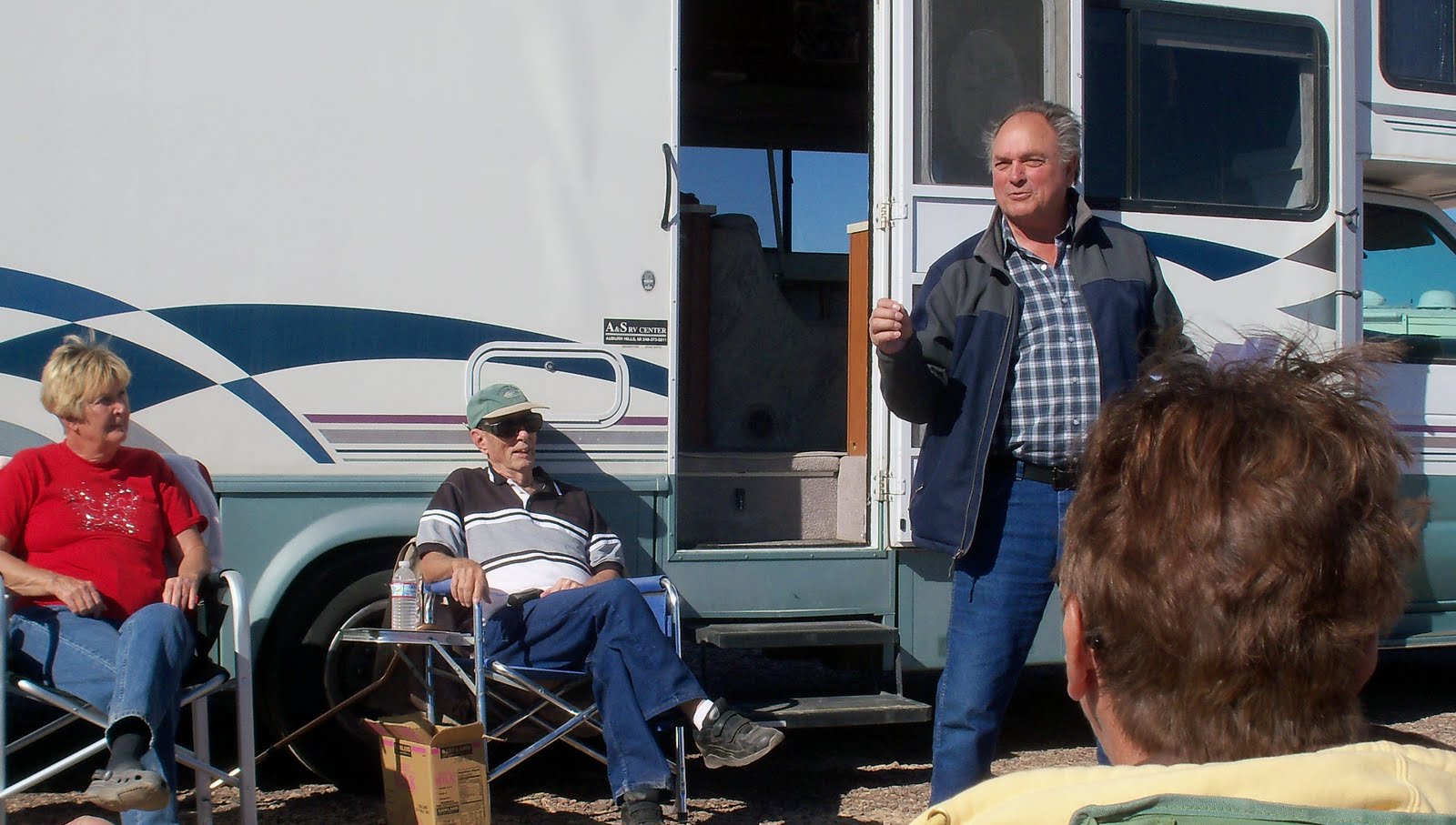
A TRIBAL TRIBUTE TO PETE BONINE. 150 members of our tribe are gathered at Quartzsite, Az for the Annual RV show and flea market.
We use the occasion to celebrate a much loved member who's been struck with Lou Gerig's disease and must hang up his keys. Those who feel especially close to him and appreciate the contribution he's made to their lives-- gather to tell him so. Vicki Bonar and Joey Shelton arrange to have him brought up from Yuma. I've been asked to lead the event.
We begin by presenting him with a box full of cards on which we have written personal messages of thanks and recollection. In the coming weeks he will surely enjoy reading them.
Then one by one people stand to reminisce events with Pete---many tell how he came to their aid---fixed their fridge or water pump or hot water heater or install solar panels. Or they talk about shared adventures down the Colorado River---an event he organized more than once. He hosted our fabulous annual Dance Rally once. He helped Brad build a whole camper.
He still has his wits about him and seems to relish being with his friends---some have been travel buddies almost 20 years. And of course I wrote a poem for the occasion---a poem that invites audience participation.
When I point to Pete--the group says "Pete Bonine."
Here's the Poem:
PETE BONINE

We've all done deeds for others' needs.
We've all helped cook and clean.
But it's doubtful if any has helped as many
as mister Pete Bonine

Who is the champ of hose and clamp?
Who is the best ever seen
at helping to mend a brake or rear end
could it be Pete Bonine?

And who gets the calls when the temperature falls
'bout troubles with our machine?
Who can fix heaters and read tricky meters?
Was it our Pete Bonine?

He has traveled and played, wandered and strayed;
camped in meadows so green;
shared our fun for a decade and one;
I speak of Pete Bonine

We've seen him whirl ladies from forties to eighties;
bask in our fireside scene;
show movies this big on the side of his rig;
Yes, it was Pete Bonine

Who viewed the whales? Who hiked the trails
with Hippies in Eugene?
Who Kayaked down the rivers brown?
Yes! It was Pete Bonine!

We friends by the dozens; closer than cousins
gather in this Quartzsite scene
to say we're proud and shout out loud:
WE LOVE YOU PETE BONINE!
At a signal, we all rose to say WE LOVE YOU PETE BONINE-----and broke into prolonged, thunderous applause. Can you see the joy on his face? Afterwards, he whispered his response to me and I shared it with the group: I love you too he said---and I enjoyed every minute with all of you---I'm thankful to God for the ability to fix things---it was my pleasure to be helpful.
Special memory pictures were presented and special lady friends gathered around for photographs.
He bid us farewell with the courage of a hero.
RANDY PHILOSOPHIZES: "all you ever wanted to do was contribute"(Erhard) And here is living proof. My tribe---the WINs---loved, enjoyed and appreciated this man and we all relished the opportunity to tell him so--face to face. Shouldn't we do more celebration services than memorial services?


Tuesday, 15 February 2011

This is why it's so much fun to do business with the mobile operators

"Quite frankly, we’re happy that we’re not first to market with the iPhone."--Dennis Strigl, Verizon COO, 2007 (link)

"I don't think Verizon needs the Nokia and Microsoft relationship."
--Tony Melone, Verizon CEO, 2011 (link)

There's a backstory to this.  Verizon sells CDMA phones, a technology which Nokia dropped years ago.  Microsoft jerked Verizon around on the availability of the Kin phone last year.  So Verizon doesn't love either company.  On top of all that, Verizon has always been a lagging adopter of new phones.  It has a reputation for doing more testing than the other operators, and doesn't mind being late on a product or technology.

Still, the quotes are very revealing of an almost subconscious arrogance that I often see in operators around the world.  They view their customers as possessions who are allowed to buy only the phones that the operator chooses to offer.  The operator sits in the middle and extracts money from everyone.  What Melone's really saying is that Microsoft and Nokia will have to pay him a lot of money in order to have the opportunity to sell phones to Verizon customers.  Never mind what the customers might want; all that matters is what the vendors do for the operator.

This is why the operators love the increasing competition between smartphone platforms.  It gives them that much more leverage to play them off against each other.

Picture yourself as a smartphone company trying to deliver a great new phone to customers.  What do you do about these restrictions?  It puts a lot more pressure on your financials and your ability to execute -- you need to create a strong brand through heavy marketing, and create products so iconic that people will demand them.

And if you're a phone customer looking to choose whichever phone you want?  The situation varies around the world.  In some places, phones have to be sold separate from mobile service.  That gives the greatest customer choice.  In many areas, you can buy a phone and then switch SIM cards to use a different network, but you lose the operator subsidy on the phone.  So it costs you hundreds of dollars to exercise freedom of choice.  But Verizon doesn't even support that level of choice, so you are stuck with only the phones that Verizon allows you to buy.

The options for Verizon customers:  Change operators (if you can find another one with coverage in your area).  Change the law to mandate free choice of phones.  Or change countries.

Monday, 14 February 2011

Impact of the Nokia-Microsoft Alliance: Welcome to the Five-Platform World

Like a big collective cow, the blogosphere is continuing to chew on the Nokia-Microsoft announcement.  It seems to be one of those rare events that forces people to stop, step back, and reconsider their assumptions.

I think it's impossible to say today what impact the Nokia-Microsoft alliance will have, because we don't know how well Nokia will execute.  If Nokia executes poorly, there won't be any change at all -- both Microsoft and Nokia will continue to gradually decline in mobile.  If Nokia executes well, I think the impact could be pretty big.  Not asteroid-killing-dinosaurs big, but a very large meteorite, with effects felt worldwide.

For the purposes of this note, I'm going to assume that both Nokia and Microsoft will execute well.  That's a risky assumption -- they would not have formed this alliance if they had been executing well in the past.  But for today we'll give them both the benefit of the doubt.


How many platforms can we stand?

Ignore the hype from Nokia about the "third platform."  The reality is that we're on track to end up with four or five significant smartphone platforms in the US and Europe: Apple, Android, RIM, Windows Phone, and HP/Palm if their new products are excellent.  Japan as usual will be very different, and I don't think all five players will be equally active worldwide.

You might ask if the market can accommodate five platforms.  There's a school of thought that says the smartphone market is destined to go the way of the PC market -- eventually almost everyone will coalesce on a single platform that has the most applications and licensees.  If that's how smartphones are destined to work, nobody seems to have told the customers.  Platforms with small numbers of apps (RIM in particular) have continued to sell well.  Also, back when I was at Palm and we had far more apps than any other mobile device, it didn't let us destroy Pocket PC, or RIM, or Symbian.

I think apps do matter in smartphones, but so far they appear to matter less than they do in PCs.  Without any apps, a PC is useless, whereas most smartphones ship with a lot of functions built in: voice telephony, texting, e-mail, browser, camera, etc.  Third party apps are more gravy than steak, at least for now.

So maybe the magic number is two platforms.  In marketing, many experts believe customers can hold only two major brands in their heads for any market: a leader and a challenger.  Think Coke and Pepsi, Hertz and Avis, Airbus and Boeing.  On the other hand, there are plenty of markets which have dozens of competitors.  Automobiles, for instance.  You can have huge numbers of successful brands there because the market is heavily segmented -- Rolls Royce doesn't compete with Mini Cooper.

I believe the number of smartphone vendors and platforms is going to depend on the actions of the smartphone companies themselves.  If they treat smartphones like a single consolidated market, a shakeout is probably inevitable.  If they segment the market, creating brands and devices that serve different groups of customers differently, I think there's room for all the platforms to survive.

Unfortunately, at this point most of the smartphone companies are focusing only on slavishly copying Apple.  Even RIM, a company with differentiated communicator products, is trying desperately to turn them into iPhone clones.  That's a great strategy to ensure commoditization and market dominance by Apple.

Since we're giving Nokia the benefit of the doubt today, let's assume they create differentiated products that help to segment the market.  I think that would stimulate other handset companies to do the same thing, leading to a relatively stable multiplatform world.

Here's what that means to the rest of the industry...


For the Android licensees, there will be intense competition for shelf space

In a five platform world, I think it'll be hard for all of the Android licensees to survive.  Picture your typical Verisprint store a couple of years from now (Vodorange if you're in Europe).  It probably carries three iPhone devices, because Apple has diversified its line.  There are a couple of RIM devices with keyboards.  We're assuming Nokia and Microsoft are successful, so there are a couple of Nokia smartphones on display.  Since we're giving the benefit of the doubt, we'll also assume HP has paid big comarketing dollars to get two of its devices shelved.  That's nine smartphones.  How much space is left for Android models?  I figure maybe two or three devices, split between Samsung, HTC, Motorola, SonyEricsson, LG, etc.  Life gets very uncomfortable for a couple of those companies.

Or maybe they get lucky and a RIM or HP gets knocked out of the picture.  That would leave space for more Android vendors.  But the Android licensees can't control that -- they're counting on Google to drive one or two of the other handset platforms out of business.  Is Google prepared to fight that sort of alley knife-fight against an HP or RIM, companies that might otherwise be Google partners? 

Android was a fun product for Google when all it meant was bleeding Microsoft.  But it eventually made Apple into an enemy, and now Nokia.  HP is next, and RIM will come after unless it licenses Android.  Is that the lifestyle Google wants?  I doubt it.

By the way, I think the Android shelf space problem is one of the reasons why Nokia went with Microsoft rather than Google.  Nokia has more control over its fate as a Windows Phone vendor, and it knows Microsoft is willing to do anything to win.


What happens to the other Windows Phone licensees? 

It's really hard for me to picture them sticking with the platform in more than a token fashion.  They avoided Symbian because it was a stacked deck in Nokia's favor; I think Windows Phone now looks the same.  The only way they'd invest more is if Nokia's WinPhone products started to take off strongly in a couple of years, and they were afraid of being left out.  I presume that's what Microsoft is counting on (it's how they dealt with IBM in PCs).


Can HP really be the fifth platform? 

HP is by far the weakest of the five mobile platforms.  Although it has a great legacy, it has neglected its developers tragically and its products are late.  The recent HP event shows it still has a legacy of goodwill in Silicon Valley, and you can't count out the world's largest PC company.  But HP's success depends on great execution.  If its products are timely and deliver on their promises, I think it has a good shot.  I am especially impressed by the things HP wants to do to link its products together (another on the long list of things Microsoft fumbled years ago).

But can HP execute?  It's been steering a zigzag course in PCs.  For several years it invested heavily in differentiation, and hired a lot of former Apple staffers.  But in the last year it laid off many of those people, killed its advertising campaign, and focused on Acer-style price competition.  Now suddenly HP is talking like it wants to go back to being a differentiated premium vendor.  That sort of inconsistency will be deadly when competing directly with the other smartphone platforms.

I can't figure out if the HP guys are Jedi knights or middle-aged paunchy men playing with plastic swords.  Based on history, I'm about 60-40 in favor of the plastic swords.


For the mobile operators, all of this produces immense happiness

Sometimes it's better to be lucky than good, and the Nokia-Microsoft deal is a huge stroke of luck for the operators.  They have always wanted the handset vendors to be barefoot and pregnant, too weak and divided to fight with them for control over phone customers.  A five-platform world is immensely attractive to them because the platforms can be played off against one another.  If RIM gets too uppity, you can just tip the product mix toward HP, or vice-versa.

The downside of this for the operators is that five platforms are a lot more work to support.  So they'll have conflicting temptations -- carrying more platforms gives them more leverage, but adds to their costs.  I think the biggest operators will choose the leverage; Verizon proved that it's not healthy to be cut off from a successful platform, and you can never tell which one is going to be successful next. 


For app developers, there will be more pain

The prospect of a five platform market is a nightmare for developers.  It's already hard to support two platforms (Apple and Android); the idea of supporting five is a logistical nightmare.  Most developers will focus on one or two, but that limits their potential revenue because the available market is smaller.

This situation favors large established developers that can afford to do ports to all the platforms.  Unfortunately, large software companies are usually the slowest to innovate, so I fear the net result of a five-platform world is likely to be less innovation in mobile apps.

There will probably be intense interest in cross-platform development environments that let a developer write once and deploy anywhere.  The platform companies will resist, and probably governments will eventually get dragged into the debate as they are asked to define what constitutes restraint of trade in an online app marketplace.

The one silver lining might be if the platform vendors start to compete for developers by giving them benefits -- for example, by loosening restrictions in their app stores, and taking a smaller cut of revenue.  I hope that will happen, but it's not enough to make up for the fractured development platform.


What it means to Nokia: A chance to survive

Although Europe is really a collection of nations rather than a single place, there are a few things that seem to tug on heartstrings across many European countries.  The Eurovision song contest is one, Airbus is another, and Nokia is a third.  It represents European style and marketing prowess, and it proves that people in Europe can lead a high-tech industry.  So the deal with Microsoft represents far more than a business deal; it feels like a betrayal of a European jewel at the hands of a rapacious American company.

It's important to understand what the alternative was for Nokia.  If the company had continued at current course and speed, the decline in gross margins would have put it close to breakeven this year, and it would have started losing money in 2012.  Things were already so bad that restoring 10% operating profit this year would require laying off about a third of the company.  Obviously the cuts won't be that severe because Elop is aiming at a multiyear recovery, but the numbers show how close Nokia was to a death spiral in which spending cuts and revenue declines start reinforcing each other.

Nokia was like a plane rapidly losing altitude.  If you don't pull back on the yoke in time, there's nothing you can do to avoid hitting the ground.  The company was very close to that point.

I believe Nokia's directors knew this when they hired Stephen Elop, and his charter was to restructure the company radically before the problems became unsolvable.  In that sort of situation, you don't ask what products you ought to save.  You figure out how much money you can spend, you make a prioritized list of everything you do, and you start cutting from the bottom of the list until your activities fit into the budget.

I think when Elop and the board did that exercise, all of Nokia's OS business was below the line.  They just couldn't afford it.

Although stepping back from OS is emotionally devastating to many Nokia employees and fans, I don't think it's necessarily bad for the company.  Operating systems are like plumbing; they don't actually add much value to the building, but if they're built wrong they can destroy it.  Symbian advocates talked persuasively about its superior power management and ability to run on low-cost hardware, but as far as I can tell that was never reflected in higher margins for Nokia smartphones.  Most Symbian users didn't even know the OS was there, and if they had they would not have paid extra for it.  Symbian was enormously complex and difficult to work with, and it cost Nokia a fortune.  According to Nokia's annual reports, it paid about $800 million when it bought Symbian, and it reportedly employed at least 2,500 Symbian engineers (link).  Those engineers probably cost about $500m a year, or about $5 per Symbian phone sold.

Nokia went into the OS business because it was afraid of depending on someone else's plumbing.  Now it's betting that Microsoft is weakened enough that it'll actually cooperate with Nokia.  Microsoft will reportedly end up paying Nokia more than a billion dollars to adopt Windows Phone (link), and Nokia can reassign the Symbian engineers to tasks that will actually differentiate Nokia's products.  The deal with Microsoft could end up being not a surrender for Nokia, but a liberation.

But as I've said before, it all depends on execution.  For the folks inside Nokia, things will feel worse before they feel better.  The layoffs are still to come, and until then it will be hard for employees to focus on their jobs.  Even after the layoffs are done, it will be a lot of months before Nokia can ship new devices designed to take advantage of Windows Phone.  Until then, Nokia is unlikely to reverse its gradual loss of share in smartphones. 

When I first held a Nokia n97, I was lost in admiration at how beautifully the hardware was put together.  Everything from the shape of the case to the motion of the sliding hinge screamed elegance.  Then I tried the software and I wanted to toss it out a window.  Nokia's smartphone task is now very simple: produce some great devices like the n97, marry them cleanly with Windows Phone, and partner with Microsoft to get them distributed as broadly as possible.

If Nokia targets those products at real customer needs, and differentiates them from the iPhone rather than just trying to top it, it has a good chance of creating the multi-platform future it's talking about.

It's not as much fun as conquering the entire tech industry, but it's a lot better than going broke.  And it's probably the only choice Nokia had.