As you've probably heard, SonyEricsson bought the UIQ user interface from Symbian this week. The only surprise in the deal was that it didn't happen a long time ago -- Symbian had been trying to unload UIQ for at least four years (they tried to sell it to Palm at least two times that I was aware of).
I haven't seen any online information about the terms of the deal, but at some point I hope it'll come out in a public filing. I'll be shocked if it turns out that SonyEricsson paid a lot of money. Knowing what it costs to create an operating system layer, I think it's very likely the UIQ team has been losing money.
With the UIQ acquisition, three of the top mobile phone companies now have their own operating system layers -- Nokia with S60, SonyEricsson with UIQ, and Motorola with whatever it's building on top of Linux.
Years ago, we were expecting to see the development of one or at most two operating systems that would run across all mobile devices. The idea was that that phones would become like PCs -- hardware decoupled from software, with low costs for consumers because the hardware was standardized and the cost of the OS and apps was spread across a huge base of hardware.
Instead, the mobile market is moving in the opposite direction, at least for now. Most of the major phone companies are creating their own OS layers, and they're not compatible with one another. I think this raises big questions for the mobile market:
What will Samsung and LG do? The other two big mobile phone companies don't have coherent software strategies, as far as I can tell. They specialize in copying others -- Samsung copies Motorola and Nokia, while LG copies Samsung. As the implications of the UIQ deal sink in, I think both Samsung and LG will start to feel they need software layers of their own. They could try to buy one, they could cut a deal with Microsoft, or they could try to write their own software layers in house.
None of the three options is attractive. There aren't a lot of mobile software layers left on the market to buy, Microsoft is well known for acting like a predator on its licensees, and creating user interfaces isn't exactly a well-known core competency of Asian hardware companies. My guess is that both Samsung and LG will continue to play the field by working with multiple operating systems, while they hope that mobile Linux will magically mature and solve their problems. But I wouldn't be shocked if one of them decided to take a chance and partner deeply with Microsoft.
What happens to Palm and RIM? RIM is going strong at the moment, while Palm is under moderate financial stress. But both are relatively small phone companies that rely heavily on software innovation for their differentiation. All that software investment makes their cost per unit a lot higher than the big guys. Their have to keep their products dramatically differentiated in order to maintain the price delta that funds their businesses.
Can they keep that edge as the big phone companies start adding more and more software value to their products? It's by no means impossible, and I wouldn't bet against the smart guys at either company. But they're both like small movie studios that fund their next movies directly from the profits of the last one. One major dud and the process could fall apart.
What about Microsoft? Theoretically, Microsoft should be cackling right now. Microsoft (and its then-buddy Intel) destroyed PC companies that were dumb enough to sell proprietary systems against the army of PC clones in the 1970s and early 1980s. Microsoft has heavy ties with the Asian phone manufacturing world, and should be able to help them produce devices which pair sophisticated software with commodity pricing. I think of this as the "HTC=Compaq" scenario.
But there are three problems with the scenario...
1. No IBM. In the PC world, Microsoft benefited immensely when IBM set a hardware design standard and then let everyone else clone it. Without IBM's help, Microsoft might never have created the clone PC market, and we'd be dealing with a much less standardized (and more expensive) PC market to this day. The closest thing to an IBM in mobile phones is Nokia, and it ain't about to let anybody clone anything, and certainly not for free.
2. No apps. The other key to Microsoft's power in PCs was the huge base of software applications that developed for DOS and Windows. People wanted Windows in order to run the apps, and Microsoft was the gatekeeper. In case nobody's noticed, mobile app sales for smartphones are miserably low, due to app distribution problems and the operators' unwillingness to allow truly open phones to be sold in mass volumes. If there's no big applications base, Microsoft doesn't have the leverage to force its software onto the world's phones.
3. Microsoft doesn't really "get" mobile. Although Microsoft's mobile software has definitely improved, the company still shows the reflexes of a PC company. It relies on cool technology to motivate customers, overloads its products with too many features for the average user, and counts on Moore's Law to bail it out over time (if you doubt this, check out David Pogue's review of the Zune media player in the New York Times). The mobile market rewards minimalist design in both hardware and software. I think that's not in Microsoft's DNA.
Is this good news for Symbian? Sure, in the sense that they've unloaded an irritant that complicated their relationship with their sugar daddy Nokia. Symbian seems to be on a path to try to make itself the embedded OS of the next generation of mobile phones -- kind of a super Nucleus. That's the only path its owners were going to tolerate anyway, so the Symbian folks might as well smile and make the best of it.
But there's no law of nature that says S60 or UIQ has to always run on top of the Symbian OS. In fact, as Nokia and SonyEricsson define more of their own application interfaces, and as the development of native Symbian applications continues to lag, there's very little to stop Nokia or SonyEricsson from moving their interfaces to run on top of a different OS. Maybe onto Linux, which doesn't charge Symbian's several dollars a unit licensing fee. The expense of supporting an OS layer team is very substantial, and only grows as the code gets older and you have to maintain it. That cost on top of the Symbian license fee is going to be pretty large even for a big phone company. The more units that Nokia and SonyEricsson build Symbian into, the more the Symbian licensing fee is going to bother them.
So Symbian is on a treadmill in which it will be under constant pressure to match the pricing of Linux. Unless Symbian can develop a big native apps base of its own, it'll have very little market power to keep its licensees loyal.
The most likely outcome in the near term will be a divided mobile market in which each of the major phone companies has its own operating system layer, with its own base of applications. Microsoft will continue to plug away with its Asian buddies, but without the critical mass to take over the phone market. We're looking at a minimum of five major OS layers (S60, UIQ, Moto Linux, Microsoft, Qualcomm Brew), plus smaller contenders (Palm OS, RIM). Oh, and don't forget Java.
This situation will drive independent software developers insane, because they'll have to rewrite their applications for every phone platform. This will drive a lot of the most creative software developers away from the mobile market; they'll continue to focus on creating web apps because they face lower barriers to entry, there's a single fairly unified platform, and they'll have more control over their own destiny.
Mobile phone enthusiasts like to point out how many mobile phones there are in the world, a much larger market than PCs. They say that larger market means the future of apps innovation will inevitably happen on mobiles. But if the mobile market is divided into five or more incompatible camps, and it's not easy to make money in any of them, the mobile apps market will be stunted indefinitely.
At some point, I believe one or more of the mobile operators will become so anxious to access the wealth of innovative web apps that they'll set up a fairly open garden for web apps developers. I don't know what software that garden will be built on -- maybe it'll be Adobe Apollo, maybe something else. But when that happens, I think we'll finally see a critical mass of third party mobile apps that will then force the other companies to deploy the same environment. It'll be a giant layer cake -- the web apps layer on top of the phone vendor's layer on top of the phone's native operating system.
The whole thing sounds incredibly baroque and inefficient, and it is. But it says something about how messed up the mobile phone apps market is, that this is the optimistic scenario for the future.
_____________
PS: Thanks to the folks at AllAboutSymbian for linking to my post on Sprint's Ambassador program in the latest Carnival of the Mobilists.
Thursday, 9 November 2006

How to segment the market for a new product
If you're interested in new product design and/or market research techniques, the latest chapter in Stop Flying Blind talks about how to define the market for a new type of product. It's not as easy as you might think, because traditional market research is focused mostly on understanding existing markets, not on defining new markets that don't yet exist.
Clayton Christensen would probably tell you that it can't be done at all. I think it can, but it's not easy, and it's definitely not research as usual.
Clayton Christensen would probably tell you that it can't be done at all. I think it can, but it's not easy, and it's definitely not research as usual.
Tuesday, 31 October 2006
Sprint recalls an Ambassador
Summary: Lessons on how to market online, courtesy of the Sprint Ambassador program.
The e-mail from Sprint came right to the point:
From: service@ambassadormail.sprint.com
Subject: Sprint Disconnection Notice
Hi,
Thank you for your participation in Phase I of the Sprint Ambassador Program. We appreciated receiving your honest and candid feedback about Sprint Power Vision and services, as well as the Samsung A920. We have been able to pass on some very specific information to the marketers, developers, and "powers that be" within Sprint for future use in making a difference in our products and services.
Please note that your six months of free service associated with Phase I of the Ambassador Program will be disconnected on: October 3, 2006.
In addition, please note that you can assign any available phone number to your phone once it has been disconnected from the Ambassador Program - thus enabling future usage of the A920 device in your local area.
Should you wish to subscribe to a Sprint voice and/or data plan, please visit us at www.Sprint.com for pricing and promotions, including Power Vision packs with Live TV, Gaming, SIRIUS Music, and more (The Weather Channel, ESPN, Comedy Time, NFL Network, NBC Mobile, etc.)
[I love that part – even when they're throwing you out of the program, they can't resist inserting an ad for their services. That's how you know you're dealing with the marketing department. –Mike]
Your access to the Sprint Ambassador Feedback Form ( http://ambassador.sprint.com ) will be disabled in correlation with your disconnection date, so now is the time to give us any additional last minute feedback you may have.
Once again, we truly appreciated your participation. Please feel free to stay in touch with us at anytime at xxxxxxxxx@Sprint.com.
Thank you,
The Sprint Ambassador Team
That's right, I'm no longer a Sprint Ambassador.
In spring, Sprint had offered me and about 400 other bloggers a free phone with six months of pre-paid 3G service. They called it the Sprint Ambassadors program. There was no obligation on my part to do anything, but Sprint was hoping we'd like the phones and write about them. Some bloggers liked the phones. Some, like me, had a few issues with them.
Okay, a lot of issues.
Ever since I posted my comments, I had been wondering what would happen next in the program. Would Sprint continue it? Would they keep me in? Now I know the answers. Looking around online, it appears that people who said nasty things about the phone were kicked out. People who said nice things (and some who said nothing at all) were given another phone and six more months of free service.
Sprint is completely within its rights to do that; they have no obligation to give free stuff to people who have criticized their products. But the Ambassadors program is interesting to me because I do a lot of work at Rubicon helping tech companies figure out how to interact with customers online. And I think Sprint has missed a great opportunity. More than that, I think what they're doing is an object lesson in how not to manage an online marketing campaign.
About the program
The Ambassador program was designed as a "word of mouth" marketing activity, according to David Dickey, Sprint's Director of Direct, Email, and SMS Marketing. Mr. Dickey has been giving speeches discussing the program. One of them is available in a podcast here. It's an interesting talk, and I encourage you to check it out for yourself. Some highlights:
--Sprint determined that the #2 driver of wireless purchases is recommendations from friends and family. The salesperson in the store is ranked #10, and TV advertisements are #19. So why not divert some of that TV money to generating better word of mouth?
--Sprint contacted 400-450 of the most influential bloggers in wireless and offered each of them a free phone. Sprint thought so highly of the phone that it believed most of the bloggers would write positively about it.
--Mr. Dickey said one risk in the program was that Sprint didn't control what the bloggers would say. He said some Sprint executives were uncomfortable with that. Most of the online commentary, he said, was very positive, but there were some negatives that were very alarming to the senior executives. That "drives a lot of activity that's not particularly positive," Mr. Dickey said. I'm picturing some pretty heated meetings or emails.
--Mr. Dickey said 65% of the bloggers accepted the phone, and 90%+ wrote positive things. He cited Buzz Machine as an example of a blog that generated good publicity, and said that the overall program generated 389,000 Google hits. "It was very successful for us."
Testing the program's effectiveness
I was curious about these statistics. In particular, the "Google hits" figure stood out to me. I'm not sure exactly what a Google hit is. The term is often used to mean the number of results returned when you search for a term on Google (you can find some examples here). But the idea that just 300 bloggers could generate 389,000 Google links seems remarkable – that's more than 1,000 references per blogger. So I did a search on Google for the term "Sprint Ambassador." That yielded 26,100 links. The same search on Yahoo produced 26,900 links.
So already Sprint seems to be off by a factor of ten. But the picture gets trickier. After the first 280 links, Google reports that the rest are all "very similar." That means some of the 26,000 results are duplicate copies of the same posts, while others will be additional posts on the same websites. Those will pull a much smaller audience than new posts on separate blogs would. So the number of truly unique mentions of "Sprint Ambassador" is probably well under 26,000. I think that's much more realistic considering that Sprint sent out about 300 phones.
But then where did the 389,000 figure come from? I can think of two possibilities:
1. If you take off the quote marks, searching for the words sprint ambassador will yield half a million hits. But that pulls up any web page containing the word "sprint" and the word "ambassador" anywhere on the page. Most of the links would be irrelevant.
Sprint wouldn't be that inept, would it? Let's assume not.
2. Another possible explanation is that traditional advertising effectiveness is measured by impressions – the number of times you run the ad multiplied by the number of people watching or reading that media. Maybe Sprint tried to calculate the number of impressions created by those weblog posts. A few thousand citations multiplied by an average readership of a couple hundred people per blog would do the trick.
Whatever the actual number, even a few thousand comments could be very useful if they're wildly enthusiastic. But were they all enthusiastic? It's impossible to say for sure without reading thousands of weblog entries (let me know if you do it). Instead, I did some spot checks, and also read the top five search results on both Google and Yahoo (excluding links back to Sprint's own website).
I think it's fair to say that the vast majority of the comments I saw were either positive or neutral. Some people definitely liked the phone. But a large amount of the discussion – maybe the majority – was about the Ambassador program itself rather than the phone. A lot of bloggers wrote something like, "Cool, I've been made a Sprint Ambassador," but then never discussed the phone. Much of the publicity Sprint generated may have been due to the novelty of the program, rather than the phone itself.
Here's how I'd classify the top five posts on Yahoo and Google:
Top five Yahoo:
1. Marketing Shift (Jason Dowdell, an Internet entrepreneur). Talks about program, positive. Later posts are positive on the phone
2. Buzz Machine (home of Jeff Jarvis, director of interactive journalism at CUNY's grad school of journalism). Positive on the program but ends with an angry rant against Sprint (more on this below). Never discussed the phone.
3. Hyaline Skies (Eston Bond, an Internet designer). Positive on the program. No followup on the phone.
4. Paul Stamitou (a Georgia Tech student with a popular tech blog – good going, Paul). OK on the program, quite negative on the phone.
5. Pearsonified (Chris Pearson, a web designer). Very positive.
Top five Google:
1. Buzz Machine.
2. Paul Stamitou.
3. Justin Everett-Church (an evangelist at Yahoo). Positive on program, no discussion of phone.
4. Patrick Fitzgerald (a web and UI designer). Positive on program, didn't blog on phone
5. Tom Markiewicz (CEO of a web apps company). Positive on program, no discussion of phone
I thought it was ironic that Mr. Dickey singled out the BuzzMachine post as a win for Sprint. The post there is indeed complimentary about the idea of the Ambassadors program, but it ends with this paragraph:
"I TAKE BACK ALL THE NICE THINGS ABOUT SPRINT I JUST SAID: I just spent three — three! — hours on the phone with Sprint people because the phone I ordered for my parents a week ago was never put through at Sprint and I dealt with no end of cluelessness and no end of hold music and lost calls and bad attitude. You can have a good idea at the top of a company but if the culture still sucks below, your own company will torpedo you. Having subjected you to consumerist rants before, I’ll spare you the details on this one. I’ll just say that it doesn’t take much to burn up goodwill."
The post is followed by a lot of reader comments, many with additional complaints about Sprint. One of them is from someone claiming to be a Sprint customer service representative, saying that the company's customer service is indeed clueless.
I would not be quoting that one as a win.
All blogs are not created equal
But there's also another factor to consider – some blogs are more popular than others. An endorsement in a single very popular blog could outweigh ten negative posts. Unfortunately for Sprint, it ran into the opposite problem. It sent a first round phone to Joel Spolsky, CEO of a software company and author of a book on user interface design. He also happens to be author of the intensely popular weblog Joel on Software. Mr. Spolsky didn't write about the first phone at all, so Sprint sent him a second one, made by LG. He tried the second one, and had such a strong reaction that he felt compelled to write. Here's a small sample:
"All the publicity in the world is not going to help them foist on us a product that is utterly pathetic. The phones they send us are so lame there is literally no area you can go into without being disappointed and shocked at just how shoddy everything is and how much it costs and what a rip off scam they’re trying to run here with the music that costs too much and the movies that you don’t want to watch on the screen that makes them unwatchable and you just KNOW that if you call to cancel the extra $7/month, their customer service department is going to give you the phone menu runaround and then put you on hold for an hour and then you’ll get some cancellation specialist with an incomprehensible accent who will spend 15 minutes trying to talk you out of canceling the useless service until you just give up and let them have the goddamned $7 a month. No amount of pampering bloggers and calling them Ambassadors is going to get around the fact that you’re sending us plastic junk phones that look like bath toys. (Hey, does it float?) All the “tipping point” theories in the world won’t protect Sprint from the basic truth that the LG Fusic user interface could basically serve as an almost complete textbook for a semester-long course in user interface design, teaching students of usability exactly what NOT to do."
It goes on and on for pages.
The Spolsky post was picked up in a lot of other places, notably the very popular weblog of Robert Scoble ("Don't send bloggers stuff for free unless it's good"), and on CNet Reviews ("When bribing bloggers doesn't pay"). All of those are extremely high traffic sites. To put it in perspective, according to Alexa.com the CNet Reviews site gets about ten times the daily traffic of Sprint.com, while Scoble + Spolsky together are about half the volume of Sprint.com. So even though they count as only three links on Mr. Dickey's list, they outweigh the mentions from hundreds of lower-traffic blogs.
[By the way, I know Alexa's site rankings skew toward technophiles, but that's the crowd Sprint was trying to influence, so I think it's an appropriate benchmark in this case.]
Lessons from the Sprint Ambassadors program
Since we don't know what Sprint's goals were, it's impossible to say if the program was a success. In particular, I don't want to run Mr. Dickey under the bus, because in a traditionally-organized company the marketing folks are supposed to assume that the engineers create good products, and to market them as vigorously as possible. That's what Sprint's marketing department did. The problem is that the traditional stovepiped approach doesn't work very well on the Web. So I think Sprint Ambassadors was a missed opportunity because it wasn't nearly as effective as it could have been. Here's my take on the lessons:
Engage before you seed. You really need to understand the people you're seeding products to. I think Sprint was very sincere when they said they thought their product was wonderful and that everyone would love it. That just proves how utterly out of touch Sprint is with the computing community. Anybody who has studied the principles of good interface design, as taught in the computing world, would immediately spot numerous flaws in Sprint's interface.
This is a recurring problem for the mobile phone companies. They tend to operate in an inward-focused world where their only reference points are other phone companies. I experienced this vividly recently in an e-mail exchange with a website that focuses on the mobile phone industry. They gave an award to the Sprint online music store, the same store that Joel Spolsky and I both criticized. I asked someone at the website why they gave an award to the Sprint store. "It's so much better than Verizon's store," was the reply.
Silly me, I compared it to iTunes.
When you engage with bloggers, you're operating on their turf, and they will judge you according to their values. You had darned well better understand those values before you send them products.
Engage two-way. Companies use a lot of different communication media to talk to their customers – television, radio, print ads, and so on. But the Web is different from almost every other medium, because it's at least potentially two-way. Instead of just shooting messages out at your "target" customers, you can actually have conversations with them. This creates all sorts of interesting opportunities for learning from your customers, and for building very tight relationships with them.
But you can do that only if you dramatically adjust the way you plan and manage your marketing. If you're going to have a conversation with the customer, you need to have other parts of your company involved in answering back – it can't just be a project of the marketing department, because the customers won't want to talk about only marketing issues. And ironically, it's often even more important to engage with your critics than it is to engage with the people who love you. If you encourage a fan to spread the word about you, that's good. But if you turn around a critic, you get a double benefit – you gain more recommendations, and you cut off a source of criticism.
People who are active online understand the two-way nature of the medium, and expect others to understand it as well. They get offended pretty quickly if a company uses the web to communicate one-way. Websites that don't encourage comments, and e-mail messages that can't be responded to, are viewed as rude and depersonalized. As a marketeer, you may think you're reaching out to people online when in fact, if you don't make your communication two-way, the message you're giving is that you don't care.
Sprint's program was almost completely one-way. Although there's a web form that Ambassadors can use to send comments, the box is sized for about four lines of text. All of the messages the program sent out were impersonal group mailings from an anonymous sender. There was no effort to establish a two-way dialog, let along a dialog among the Ambassadors, and in most cases you weren't even sure if anyone at Sprint was listening to comments.
Here's what I think Sprint should have done. First, engage with a small group of bloggers, and make the communication truly two-way. Really listen to them. Then later, when Sprint expanded the program, it would have had a much better idea of what might happen, and the original members would have served as a core to orient everyone else and bring them into the conversation.
If Sprint had engaged the ambassadors in a genuine dialog, we would probably have given our negative feedback in private first. That would have given Sprint a chance to respond, and even if we had gone ahead and posted some negative comments, they would have been softer, and we would have felt obliged to point out that Sprint was listening to us and had some reasonable employees.
For example, can you imagine that Jeff Jarvis would have posted his angry rant at Sprint if they had given him the name of a real person to contact as part of the Ambassador program?
Some companies would say that they don't have the resources to engage this deeply, but it's only 300 bloggers and Sprint is a multi-billion dollar company. They can easily afford it. And besides, by engaging halfway they did just enough to stimulate criticism but not enough to head it off.
I worry that all Sprint did was to position itself in a lot of influential peoples' minds as yet another company that doesn't understand the Web.
Understand what life is like for major bloggers. Popular bloggers are inundated with messages asking them to review products. Mobile Opportunity is extremely low-volume compared to the popular blogs, but even I get a steady stream of messages asking me to promote products or link to posts. In that context, Sprint's offer probably felt to the major bloggers like just one more in a flood of efforts to exploit their blogs. I think that's what made Joel Spolsky cautions, and it contributed to the rant he wrote.
Get real about the statistics. Web statistics are a snake pit. There's no reliable source of data (even the Alexa figures I quoted are highly suspect), and companies quote whichever number makes them look good. But we should all use a little common sense. Is there any way that sending out just 300 free phones is going to generate 400,000 separate links? I think it's not physically possible. Besides, a ten-second check on Google and Yahoo showed the number was way off.
The sad thing is that I couldn't find any article anywhere questioning Sprint's number. Even CNet's negative article repeated it without a touch of skepticism.
What do you think? Am I being too hard on Sprint? Are there other lessons I've missed? The world of online marketing is still developing. We're spending a lot of time understanding and teaching it at Rubicon, but I don't pretend we have all the answers. Please share your thoughts...
The e-mail from Sprint came right to the point:
From: service@ambassadormail.sprint.com
Subject: Sprint Disconnection Notice
Hi,
Thank you for your participation in Phase I of the Sprint Ambassador Program. We appreciated receiving your honest and candid feedback about Sprint Power Vision and services, as well as the Samsung A920. We have been able to pass on some very specific information to the marketers, developers, and "powers that be" within Sprint for future use in making a difference in our products and services.
Please note that your six months of free service associated with Phase I of the Ambassador Program will be disconnected on: October 3, 2006.
In addition, please note that you can assign any available phone number to your phone once it has been disconnected from the Ambassador Program - thus enabling future usage of the A920 device in your local area.
Should you wish to subscribe to a Sprint voice and/or data plan, please visit us at www.Sprint.com for pricing and promotions, including Power Vision packs with Live TV, Gaming, SIRIUS Music, and more (The Weather Channel, ESPN, Comedy Time, NFL Network, NBC Mobile, etc.)
[I love that part – even when they're throwing you out of the program, they can't resist inserting an ad for their services. That's how you know you're dealing with the marketing department. –Mike]
Your access to the Sprint Ambassador Feedback Form ( http://ambassador.sprint.com ) will be disabled in correlation with your disconnection date, so now is the time to give us any additional last minute feedback you may have.
Once again, we truly appreciated your participation. Please feel free to stay in touch with us at anytime at xxxxxxxxx@Sprint.com.
Thank you,
The Sprint Ambassador Team
That's right, I'm no longer a Sprint Ambassador.
In spring, Sprint had offered me and about 400 other bloggers a free phone with six months of pre-paid 3G service. They called it the Sprint Ambassadors program. There was no obligation on my part to do anything, but Sprint was hoping we'd like the phones and write about them. Some bloggers liked the phones. Some, like me, had a few issues with them.
Okay, a lot of issues.
Ever since I posted my comments, I had been wondering what would happen next in the program. Would Sprint continue it? Would they keep me in? Now I know the answers. Looking around online, it appears that people who said nasty things about the phone were kicked out. People who said nice things (and some who said nothing at all) were given another phone and six more months of free service.
Sprint is completely within its rights to do that; they have no obligation to give free stuff to people who have criticized their products. But the Ambassadors program is interesting to me because I do a lot of work at Rubicon helping tech companies figure out how to interact with customers online. And I think Sprint has missed a great opportunity. More than that, I think what they're doing is an object lesson in how not to manage an online marketing campaign.
About the program
The Ambassador program was designed as a "word of mouth" marketing activity, according to David Dickey, Sprint's Director of Direct, Email, and SMS Marketing. Mr. Dickey has been giving speeches discussing the program. One of them is available in a podcast here. It's an interesting talk, and I encourage you to check it out for yourself. Some highlights:
--Sprint determined that the #2 driver of wireless purchases is recommendations from friends and family. The salesperson in the store is ranked #10, and TV advertisements are #19. So why not divert some of that TV money to generating better word of mouth?
--Sprint contacted 400-450 of the most influential bloggers in wireless and offered each of them a free phone. Sprint thought so highly of the phone that it believed most of the bloggers would write positively about it.
--Mr. Dickey said one risk in the program was that Sprint didn't control what the bloggers would say. He said some Sprint executives were uncomfortable with that. Most of the online commentary, he said, was very positive, but there were some negatives that were very alarming to the senior executives. That "drives a lot of activity that's not particularly positive," Mr. Dickey said. I'm picturing some pretty heated meetings or emails.
--Mr. Dickey said 65% of the bloggers accepted the phone, and 90%+ wrote positive things. He cited Buzz Machine as an example of a blog that generated good publicity, and said that the overall program generated 389,000 Google hits. "It was very successful for us."
Testing the program's effectiveness
I was curious about these statistics. In particular, the "Google hits" figure stood out to me. I'm not sure exactly what a Google hit is. The term is often used to mean the number of results returned when you search for a term on Google (you can find some examples here). But the idea that just 300 bloggers could generate 389,000 Google links seems remarkable – that's more than 1,000 references per blogger. So I did a search on Google for the term "Sprint Ambassador." That yielded 26,100 links. The same search on Yahoo produced 26,900 links.
So already Sprint seems to be off by a factor of ten. But the picture gets trickier. After the first 280 links, Google reports that the rest are all "very similar." That means some of the 26,000 results are duplicate copies of the same posts, while others will be additional posts on the same websites. Those will pull a much smaller audience than new posts on separate blogs would. So the number of truly unique mentions of "Sprint Ambassador" is probably well under 26,000. I think that's much more realistic considering that Sprint sent out about 300 phones.
But then where did the 389,000 figure come from? I can think of two possibilities:
1. If you take off the quote marks, searching for the words sprint ambassador will yield half a million hits. But that pulls up any web page containing the word "sprint" and the word "ambassador" anywhere on the page. Most of the links would be irrelevant.
Sprint wouldn't be that inept, would it? Let's assume not.
2. Another possible explanation is that traditional advertising effectiveness is measured by impressions – the number of times you run the ad multiplied by the number of people watching or reading that media. Maybe Sprint tried to calculate the number of impressions created by those weblog posts. A few thousand citations multiplied by an average readership of a couple hundred people per blog would do the trick.
Whatever the actual number, even a few thousand comments could be very useful if they're wildly enthusiastic. But were they all enthusiastic? It's impossible to say for sure without reading thousands of weblog entries (let me know if you do it). Instead, I did some spot checks, and also read the top five search results on both Google and Yahoo (excluding links back to Sprint's own website).
I think it's fair to say that the vast majority of the comments I saw were either positive or neutral. Some people definitely liked the phone. But a large amount of the discussion – maybe the majority – was about the Ambassador program itself rather than the phone. A lot of bloggers wrote something like, "Cool, I've been made a Sprint Ambassador," but then never discussed the phone. Much of the publicity Sprint generated may have been due to the novelty of the program, rather than the phone itself.
Here's how I'd classify the top five posts on Yahoo and Google:
Top five Yahoo:
1. Marketing Shift (Jason Dowdell, an Internet entrepreneur). Talks about program, positive. Later posts are positive on the phone
2. Buzz Machine (home of Jeff Jarvis, director of interactive journalism at CUNY's grad school of journalism). Positive on the program but ends with an angry rant against Sprint (more on this below). Never discussed the phone.
3. Hyaline Skies (Eston Bond, an Internet designer). Positive on the program. No followup on the phone.
4. Paul Stamitou (a Georgia Tech student with a popular tech blog – good going, Paul). OK on the program, quite negative on the phone.
5. Pearsonified (Chris Pearson, a web designer). Very positive.
Top five Google:
1. Buzz Machine.
2. Paul Stamitou.
3. Justin Everett-Church (an evangelist at Yahoo). Positive on program, no discussion of phone.
4. Patrick Fitzgerald (a web and UI designer). Positive on program, didn't blog on phone
5. Tom Markiewicz (CEO of a web apps company). Positive on program, no discussion of phone
I thought it was ironic that Mr. Dickey singled out the BuzzMachine post as a win for Sprint. The post there is indeed complimentary about the idea of the Ambassadors program, but it ends with this paragraph:
"I TAKE BACK ALL THE NICE THINGS ABOUT SPRINT I JUST SAID: I just spent three — three! — hours on the phone with Sprint people because the phone I ordered for my parents a week ago was never put through at Sprint and I dealt with no end of cluelessness and no end of hold music and lost calls and bad attitude. You can have a good idea at the top of a company but if the culture still sucks below, your own company will torpedo you. Having subjected you to consumerist rants before, I’ll spare you the details on this one. I’ll just say that it doesn’t take much to burn up goodwill."
The post is followed by a lot of reader comments, many with additional complaints about Sprint. One of them is from someone claiming to be a Sprint customer service representative, saying that the company's customer service is indeed clueless.
I would not be quoting that one as a win.
All blogs are not created equal
But there's also another factor to consider – some blogs are more popular than others. An endorsement in a single very popular blog could outweigh ten negative posts. Unfortunately for Sprint, it ran into the opposite problem. It sent a first round phone to Joel Spolsky, CEO of a software company and author of a book on user interface design. He also happens to be author of the intensely popular weblog Joel on Software. Mr. Spolsky didn't write about the first phone at all, so Sprint sent him a second one, made by LG. He tried the second one, and had such a strong reaction that he felt compelled to write. Here's a small sample:
"All the publicity in the world is not going to help them foist on us a product that is utterly pathetic. The phones they send us are so lame there is literally no area you can go into without being disappointed and shocked at just how shoddy everything is and how much it costs and what a rip off scam they’re trying to run here with the music that costs too much and the movies that you don’t want to watch on the screen that makes them unwatchable and you just KNOW that if you call to cancel the extra $7/month, their customer service department is going to give you the phone menu runaround and then put you on hold for an hour and then you’ll get some cancellation specialist with an incomprehensible accent who will spend 15 minutes trying to talk you out of canceling the useless service until you just give up and let them have the goddamned $7 a month. No amount of pampering bloggers and calling them Ambassadors is going to get around the fact that you’re sending us plastic junk phones that look like bath toys. (Hey, does it float?) All the “tipping point” theories in the world won’t protect Sprint from the basic truth that the LG Fusic user interface could basically serve as an almost complete textbook for a semester-long course in user interface design, teaching students of usability exactly what NOT to do."
It goes on and on for pages.
The Spolsky post was picked up in a lot of other places, notably the very popular weblog of Robert Scoble ("Don't send bloggers stuff for free unless it's good"), and on CNet Reviews ("When bribing bloggers doesn't pay"). All of those are extremely high traffic sites. To put it in perspective, according to Alexa.com the CNet Reviews site gets about ten times the daily traffic of Sprint.com, while Scoble + Spolsky together are about half the volume of Sprint.com. So even though they count as only three links on Mr. Dickey's list, they outweigh the mentions from hundreds of lower-traffic blogs.
[By the way, I know Alexa's site rankings skew toward technophiles, but that's the crowd Sprint was trying to influence, so I think it's an appropriate benchmark in this case.]
Lessons from the Sprint Ambassadors program
Since we don't know what Sprint's goals were, it's impossible to say if the program was a success. In particular, I don't want to run Mr. Dickey under the bus, because in a traditionally-organized company the marketing folks are supposed to assume that the engineers create good products, and to market them as vigorously as possible. That's what Sprint's marketing department did. The problem is that the traditional stovepiped approach doesn't work very well on the Web. So I think Sprint Ambassadors was a missed opportunity because it wasn't nearly as effective as it could have been. Here's my take on the lessons:
Engage before you seed. You really need to understand the people you're seeding products to. I think Sprint was very sincere when they said they thought their product was wonderful and that everyone would love it. That just proves how utterly out of touch Sprint is with the computing community. Anybody who has studied the principles of good interface design, as taught in the computing world, would immediately spot numerous flaws in Sprint's interface.
This is a recurring problem for the mobile phone companies. They tend to operate in an inward-focused world where their only reference points are other phone companies. I experienced this vividly recently in an e-mail exchange with a website that focuses on the mobile phone industry. They gave an award to the Sprint online music store, the same store that Joel Spolsky and I both criticized. I asked someone at the website why they gave an award to the Sprint store. "It's so much better than Verizon's store," was the reply.
Silly me, I compared it to iTunes.
When you engage with bloggers, you're operating on their turf, and they will judge you according to their values. You had darned well better understand those values before you send them products.
Engage two-way. Companies use a lot of different communication media to talk to their customers – television, radio, print ads, and so on. But the Web is different from almost every other medium, because it's at least potentially two-way. Instead of just shooting messages out at your "target" customers, you can actually have conversations with them. This creates all sorts of interesting opportunities for learning from your customers, and for building very tight relationships with them.
But you can do that only if you dramatically adjust the way you plan and manage your marketing. If you're going to have a conversation with the customer, you need to have other parts of your company involved in answering back – it can't just be a project of the marketing department, because the customers won't want to talk about only marketing issues. And ironically, it's often even more important to engage with your critics than it is to engage with the people who love you. If you encourage a fan to spread the word about you, that's good. But if you turn around a critic, you get a double benefit – you gain more recommendations, and you cut off a source of criticism.
People who are active online understand the two-way nature of the medium, and expect others to understand it as well. They get offended pretty quickly if a company uses the web to communicate one-way. Websites that don't encourage comments, and e-mail messages that can't be responded to, are viewed as rude and depersonalized. As a marketeer, you may think you're reaching out to people online when in fact, if you don't make your communication two-way, the message you're giving is that you don't care.
Sprint's program was almost completely one-way. Although there's a web form that Ambassadors can use to send comments, the box is sized for about four lines of text. All of the messages the program sent out were impersonal group mailings from an anonymous sender. There was no effort to establish a two-way dialog, let along a dialog among the Ambassadors, and in most cases you weren't even sure if anyone at Sprint was listening to comments.
Here's what I think Sprint should have done. First, engage with a small group of bloggers, and make the communication truly two-way. Really listen to them. Then later, when Sprint expanded the program, it would have had a much better idea of what might happen, and the original members would have served as a core to orient everyone else and bring them into the conversation.
If Sprint had engaged the ambassadors in a genuine dialog, we would probably have given our negative feedback in private first. That would have given Sprint a chance to respond, and even if we had gone ahead and posted some negative comments, they would have been softer, and we would have felt obliged to point out that Sprint was listening to us and had some reasonable employees.
For example, can you imagine that Jeff Jarvis would have posted his angry rant at Sprint if they had given him the name of a real person to contact as part of the Ambassador program?
Some companies would say that they don't have the resources to engage this deeply, but it's only 300 bloggers and Sprint is a multi-billion dollar company. They can easily afford it. And besides, by engaging halfway they did just enough to stimulate criticism but not enough to head it off.
I worry that all Sprint did was to position itself in a lot of influential peoples' minds as yet another company that doesn't understand the Web.
Understand what life is like for major bloggers. Popular bloggers are inundated with messages asking them to review products. Mobile Opportunity is extremely low-volume compared to the popular blogs, but even I get a steady stream of messages asking me to promote products or link to posts. In that context, Sprint's offer probably felt to the major bloggers like just one more in a flood of efforts to exploit their blogs. I think that's what made Joel Spolsky cautions, and it contributed to the rant he wrote.
Get real about the statistics. Web statistics are a snake pit. There's no reliable source of data (even the Alexa figures I quoted are highly suspect), and companies quote whichever number makes them look good. But we should all use a little common sense. Is there any way that sending out just 300 free phones is going to generate 400,000 separate links? I think it's not physically possible. Besides, a ten-second check on Google and Yahoo showed the number was way off.
The sad thing is that I couldn't find any article anywhere questioning Sprint's number. Even CNet's negative article repeated it without a touch of skepticism.
What do you think? Am I being too hard on Sprint? Are there other lessons I've missed? The world of online marketing is still developing. We're spending a lot of time understanding and teaching it at Rubicon, but I don't pretend we have all the answers. Please share your thoughts...
Monday, 30 October 2006
How Codgerism Can Save the World
Codger-style living is at heart a values shift–away from status and power toward freedom, mobility, and creativity. Millions are slowly discovering the happy truth, that these are what really satisfy.
A side effect of this value shift is that it can save the world from its greatest evils.
Homelessness: This is a ridiculously easy problem for codgers to solve, because we know the difference between shelter and status symbol. What we know that others don't is that cozy mobile accomodations can be had for peanuts. Almost as importantly, we know where we can park for less than peanuts. To approximately quote one of the great codgers, Thoreau, the cause of most homelessness is not so much a lack of money as a lack of imagination.
Global Warming: Our low consumption, off-the-electrical-grid lifestyle adds almost nothing to CO2 levels in the atmosphere. Factories and power plants can scale way back when millions of greedy, insatiable, munching caterpillars transform to codger butterflies fluttering about the continent, powered by sunlight and tiny sips of nectar. Codgerism heralds the great slowdown.
Overpopulation: Mindless, reckless reproduction will cease when the codger value of sustainabilility takes hold. Codgers generally pursue values of rational self-interest, which is incompatible with a bunch of needy kids. Overcrowded, clamorous cities quickly inform his mind on the subject.
Water shortages: Codgers use from 2-4 gallons per day. Settled householders use 150 gallons per day. Need I say more?
Land shortages: Codgers do not desire to own vast tracts of land–just to use a tiny piece for a brief time.
Job shortages: The codger lifestyle is so cheap that they can retire early, opening up jobs for others. When the world adopts our low-consumption lifestyle, careers will be as short as 10 years. Drudgery is the enemy of the good life.
Fuel shortages: Confirmed codgers need 3 good reasons to go to town. They travel in short hops, consuming only a fraction of the fuel of a commuter. And all sensible codgers go south in the winter, where they hardly need any heating fuel.
Religious and Cultural Conflicts: Codgers travel and become acquainted with many cultures and religions. They soon discover that no one has a monopoly on truth. Dogmatism, chauvinism, and jingoism are abandoned. Tolerance, openness, and agnosticism become common attitudes.
A side effect of this value shift is that it can save the world from its greatest evils.
Homelessness: This is a ridiculously easy problem for codgers to solve, because we know the difference between shelter and status symbol. What we know that others don't is that cozy mobile accomodations can be had for peanuts. Almost as importantly, we know where we can park for less than peanuts. To approximately quote one of the great codgers, Thoreau, the cause of most homelessness is not so much a lack of money as a lack of imagination.
Global Warming: Our low consumption, off-the-electrical-grid lifestyle adds almost nothing to CO2 levels in the atmosphere. Factories and power plants can scale way back when millions of greedy, insatiable, munching caterpillars transform to codger butterflies fluttering about the continent, powered by sunlight and tiny sips of nectar. Codgerism heralds the great slowdown.
Overpopulation: Mindless, reckless reproduction will cease when the codger value of sustainabilility takes hold. Codgers generally pursue values of rational self-interest, which is incompatible with a bunch of needy kids. Overcrowded, clamorous cities quickly inform his mind on the subject.
Water shortages: Codgers use from 2-4 gallons per day. Settled householders use 150 gallons per day. Need I say more?
Land shortages: Codgers do not desire to own vast tracts of land–just to use a tiny piece for a brief time.
Job shortages: The codger lifestyle is so cheap that they can retire early, opening up jobs for others. When the world adopts our low-consumption lifestyle, careers will be as short as 10 years. Drudgery is the enemy of the good life.
Fuel shortages: Confirmed codgers need 3 good reasons to go to town. They travel in short hops, consuming only a fraction of the fuel of a commuter. And all sensible codgers go south in the winter, where they hardly need any heating fuel.
Religious and Cultural Conflicts: Codgers travel and become acquainted with many cultures and religions. They soon discover that no one has a monopoly on truth. Dogmatism, chauvinism, and jingoism are abandoned. Tolerance, openness, and agnosticism become common attitudes.
More: You Might Be a Codger If....
...You have not tended a lawn in 20 years.
...You haven't slept inside a house in years.
...You would make Solar Panel Day a national holiday.
...You don't pay rent, mortgage, income taxes, water or electric bills.
...You regard camping fees as tyrrany.
..."Big Rock Candy Mountain" is your favorite song.
..."Moving On" is your motto.
...Walmart is your home base.
...Quartzsite, Arizona is your mecca.
...Tumbleweed is your favorite plant.
...You haven't used a china plate in years.
..Your address is General Delivery.
...You haven't slept inside a house in years.
...You would make Solar Panel Day a national holiday.
...You don't pay rent, mortgage, income taxes, water or electric bills.
...You regard camping fees as tyrrany.
..."Big Rock Candy Mountain" is your favorite song.
..."Moving On" is your motto.
...Walmart is your home base.
...Quartzsite, Arizona is your mecca.
...Tumbleweed is your favorite plant.
...You haven't used a china plate in years.
..Your address is General Delivery.
Saturday, 28 October 2006
Applying market research to product strategy
One of the toughest tasks in the tech industry is using market research to help you make product feature decisions. A lot of people in tech feel you shouldn't do it at all – that customers aren't capable of envisioning what could be built, and if you ask them you'll just distract yourself from your vision.
On the other hand, there are a lot of companies that use market research very heavily in their product decision-making, so much so that they're reluctant to make any decisions without tangible evidence to back them up.
I think there's a middle ground, in which you can use research to help inform your decisions but not to make them for you. If you're interested in the details, you're welcome to visit the latest chapter in my online book-in-progress, Stop Flying Blind.
Tuesday, 24 October 2006
Who reads Carnival of the Mobilists?
Last week I was guest host of the Carnival of the Mobilists, a weekly collection of interesting mobile-related posts from all over the web. Along with the Carnival, I ran a little survey on its readers. Some of the results surprised me.
The poll results below are fun, but not scientific. All they tell us is the opinions of Mobilist readers who like to fill out surveys; we don't know what the rest of the readership thinks. On the other hand, about 25% of the readers filled out the survey, so that's a pretty good sample. Here's what we learned:
Our most popular services: Text, browsing, e-mail. Other than making voice calls, our most popular usages of mobile devices are, in order: texting, browsing the web, and email. But we hate downloading ringtones and photo messaging.
So much for convergence. Almost all of us carry more than one mobile device on a regular basis.
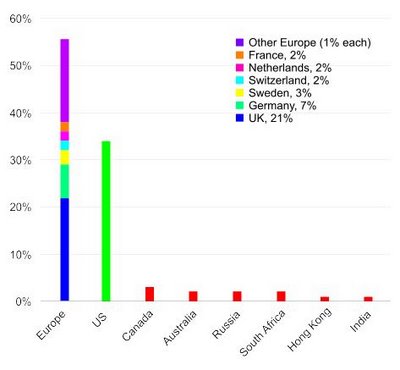
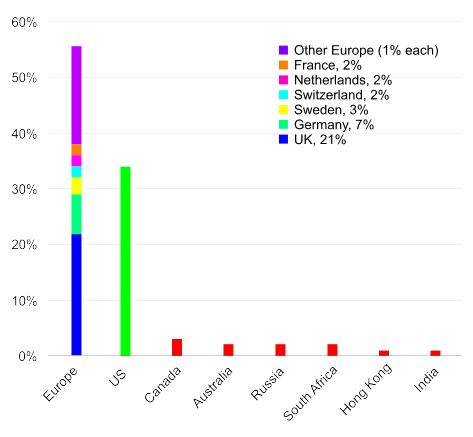
Majority European. About 55% of us are from Europe, with 21% from the UK alone. 34% are from the US. The Carnival is generally a Euro-American thing, with some Canadians and Australians spicing up the mix. I was disappointed that we have very few readers from India, Japan, southern Europe, and all of Asia other than Australia.
We are Nokia bigots. We lust after Nokia far more than any other brand of mobile device, followed distantly by Apple and SonyEricsson. There were big variations by region, though.
We're generally satisfied with the Carnival. Most of us are very happy with the Carnival. That's not too surprising – anyone who hated it would probably stop reading it, huh? But there were also a number of good suggestions, which I'll list below.
The details
Good turnout. We had 115 responses, which is about a quarter of the people who dropped by to read the Carnival that week. That's a very good response rate for this sort of survey. Thanks very much to everyone who responded!
Demographics: we're running a Euro-American stag party. We are 80-85% males, across all regions. The readership is also overwhelmingly European and American, with very few visitors from other places that do a lot of blogging in English, such as India. There are also very few readers from the southern European countries -- Italy, France, Spain, etc. Here's where the readers come from:
But we're not all the same age. The Americans among us are, on average, older than the Europeans. I don't know what to think of that.
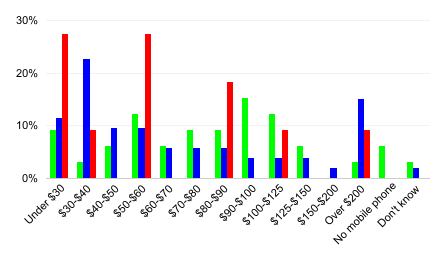
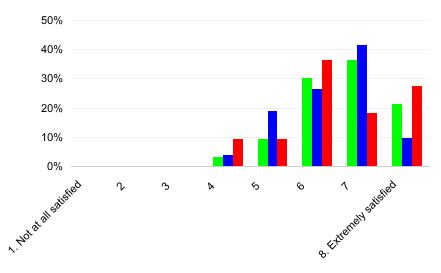
(Unless otherwise noted, the color scheme for all the charts is: green=US; blue=Europe; and red=rest of world. If you are color-blind, the order is, from left to right: US, Europe, rest of world.)
Age of Carnival readers:

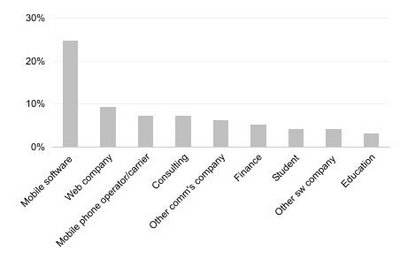
We also asked about occuptaions. There were too many different occupations to cut the results by country, but overall the largest job category was mobile software company. If you add the top four categories – mobile software company, web company, operator, and consultant – they accounted for about 50% of the total.
What type of company readers work for:
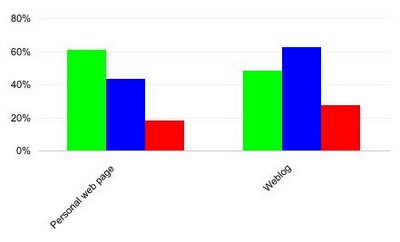
It's often said that blog authors communicate only to other blog authors. That's half true for the Carnival – about half of us have our own blogs, with the highest percentage of bloggers being in Europe.
Percent of readers having a...
To converge or not to converge? Not. I'm sure to take some flak for my interpretation of this one, but I think it's fascinating that most of us carry more than one mobile device on a regular basis. The most popular mobile device is the laptop everywhere except Europe, where the smartphone is the narrow winner.
Percent of readers carrying a particular type of device on a regular basis:
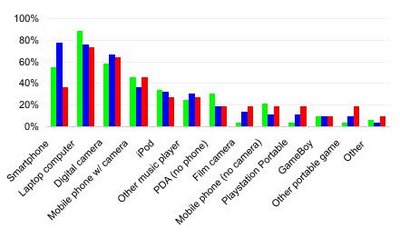
So at this point, even among the elite Mobilist readership, the smartphone is not heavily replacing the laptop for most of us. More surprising to me, the smartphone isn't at this point replacing a lot of other things either. Even if you exclude the laptop, 86% of smartphone owners carry at least one other mobile device on a regular basis.
Here are the other devices carried by smartphone owners:
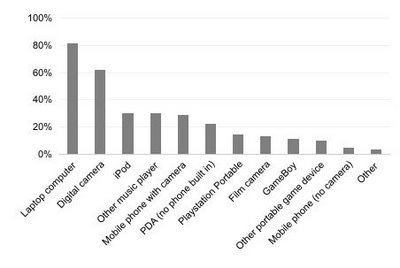
More than 60% of the smartphone owners also carry a digital camera. About 60% carry an iPod or other music player. About 30% carry a game player of some sort, and 25% carry a cameraphone in addition to their smartphone.
I know there are strong advocates of convergence among the Mobilist base, and maybe it'll happen in the future. But we haven't converged yet.
By the way, 3G penetration is higher in Europe than in the rest of the world. Here's the percent of us with 3G:

What do you do with your mobile device (other than voice calls)? Short answer: a lot. The chart below shows the percent of us who use a feature more than once a day:
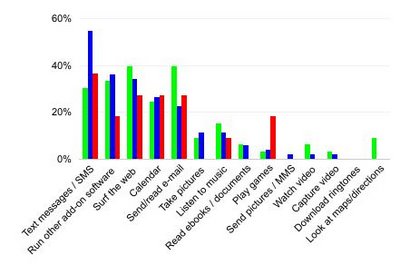
There were significant variations by region. In Europe (blue), texting is by far the king. In the US (green), the champs are e-mail and browsing. In the rest of world (red), games spiked quite a bit (although the sample is so small that I'm reluctant to draw any conclusions about that).
I was intrigued by the low scores for MMS, maps, and video – those are supposed to be three of the hottest growth areas for mobile data. So I took a different look at the data, comparing the percent of us who use a feature very frequently to the percent using it very infrequently. That lets you see which features are not used at all, versus which ones are used sometimes.
So, for example, about 30% of us use e-mail on our mobiles more than once a day, while about 25% almost never use it. The rest of us are somewhere in-between:
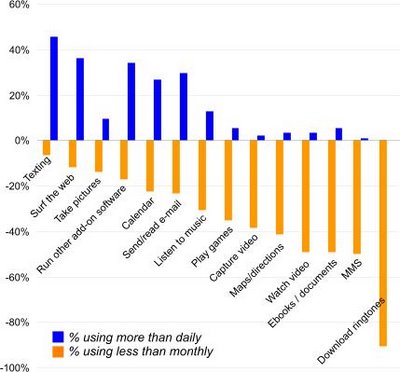
By this measure, we all hate downloading ringtones, which is very ironic since they're one of the most popular features among phone users as a whole. We also do very little picture messaging, e-book reading, and video watching. From the chart, it looks as if taking videos scored a little better, but 20% of us said our phones can't capture video. That doesn't show up in this chart, but if it did, the usage of video capture would be very low.
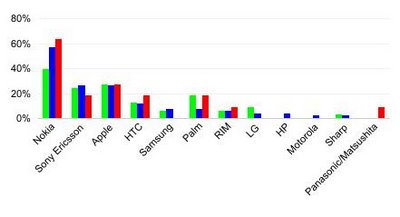
Which brands make us drool? Nokia. I was surprised by this one. Nokia inspired far, far more product lust than any other mobile brand we tested. I expected them to do well, but not this well. There were important differences by region, though – Nokia was less dominant in the US, and Palm was relatively weak in Europe.
I was shocked at the low scores we gave to RIM and Motorola. There are in this world Razr and Blackberry fanatics, but we haven't managed to include them in our readership.
This chart shows the percent of us giving a brand a seven or eight on a 1-8 scale, with eight being most lustworthy:
To understand the numbers better, I made a chart comparing the highest and lowest scores. The upper bar shows the percent of us giving a brand a score of 7 or 8 (the top of the scale), while the lower bar shows the percent of us who are very indifferent to a brand (a score of 1 or 2, or had no opinion of the brand at all):
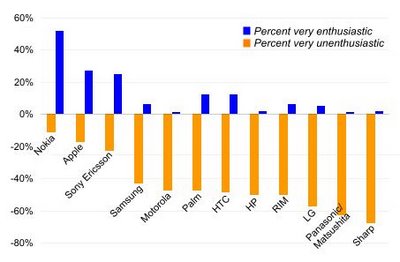
So Nokia is extremely strong, and Apple and SonyEricsson are also doing quite well (less than 20% of us were indifferent to them). Palm and HTC both had significant numbers of very enthusiastic people, although their share of indifferent people was pretty high.
I'm disappointed by the poor score we gave Sharp. Over the years, they have consistently created some of the most fascinating mobile devices. Unfortunately, most of them never make it out of Japan. And since we have virtually no Japanese readers, most of us are unaware of what Sharp's doing.
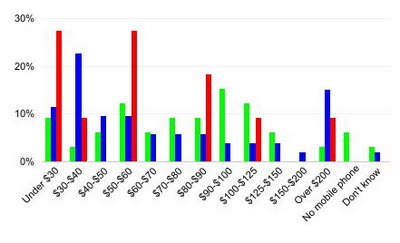
Monthly phone bill: All over the map. Usually when you ask a question like this, there's a definite curve – the responses tend to cluster in one part of the chart and then taper at either extreme. The striking thing about this chart is that there's almost no curve at all. Our phone costs are all over the map. Fifteen percent of us in Europe have monthly phone bills over $200 a month. Is this what happens when the operators don't offer flat rate data plans?
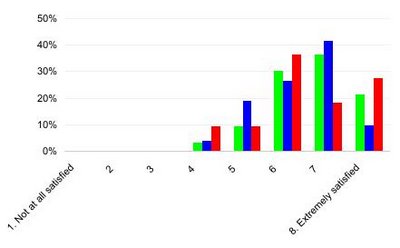
Satisfied with the Carnival. Most of us are satisfied with the Carnival, although that's to be expected since people who hate it would stop reading.
In this case, I think the written comments are more interesting than the numbers. Here they are, with groupings and a few editorial asides from me...
Happy people
Love it - great reads. I must admit I do skip some articles and only read the ones that appeal to me each week. I hope to be able to contribute later this year.
Keep up the brilliant work.
Good job everybody!
It's very good as it is.
Just keep going and keep a good balance between visionary items, technical & practical observations, entertainment stuff, usability and mobile lifestyle.
It seems quite good as it is.
Suggested features
Possibly more "Get the most out of (Insert mobile device with recently released software here) Guides"?
More information about the mobile internet - current status and future predictions.
A killer feature would be some sort of searchable catalog of past carnivals, with inclusion of their sub-links of course. [Cool! How about a meta-index of all the past Carnivals, kind of like the yearly indexes that some magazines produce? –Mike]
More photos. A forum for commentary on each article of the carnival. Creating a dialog between readers will allow more views and solutions to our wild jungle of an industry.
I find many of the articles are marketing based, this is no doubt an important area of discussion but not one which interests me much. The most interesting articles for me are those concerning everyday users and ways to make your device work best for you.
It would be cool to see how people have customised their mobiles within the community - each week have a new phone that has the best personalisation more stories about how mobile is used by the youth and generally more stories about how the people in the community use their mobile daily - my mobile day
I would like to see more articles on the mobile space in Africa, specifically South Africa where the mobile space is as advanced as any in the world, bar the far east. Certainly more advanced than the USA. Mobile technology is having a profound effect in the lives of many Africans. It is in fact helping a lot of countries bridge the technological devide.
Please more technical content. More critical. Tell me what you like/hate.
I noticed that there are only few articles in the Carnival that cover topics like PIM or alike. This is what many Smartphone-users heavily rely on...
General feedback
My original understanding was that Carnival hosts were obliged to publish every submission they received. I don't think there are a lot of low-quality posts, but there have been a few that hosts have included apparently believing that they had no say in the matter. I know this is in the host FAQ but could we clarify it somehow? [Good point, and I think we should have a discussion about this. It does vary by host. Some seem to be selective about what they link to, others (like me) link to every article that comes in during a week. My philosophy is that I don't know what info you need, so I'll let you decide. But I give much more prominent placement to the posts that I like best. –Mike]
I think the Carnival happens too frequently, which in turn lowers the quality of the writing. Most contributors are regulars and it's difficult to come up with something original every week. If I wanted to read from the same author each week, I'd probably follow his/her blog instead. I suggest to do the Carnival once per month or introduce some other measure to reduce the amount of articles/higher their quality. Maybe let the readers vote for the Top 5 articles per month.
Great summary of what is written on blogs. I would appreciate - moderated discussion as soon as carnival is released to be able to ask some questions to the authors - more insight about user experience for new services. [I like the intent behind this one, but I have a feeling that most Carnival participants would not want to move discussion of their posts off of their own blogs. Maybe I'm wrong, though. –Mike]
Often very wide range of participants. Sometimes I would have liked some focus.
Original content is what I'm looking for. There are a million aggregators but few producing thought provoking content.
Results of this survey. more questions about info or discussions, maybe some reader suggested ones.
Formatting/tone
More humour!
The themes are cute but get in the way of fast reading and comprehension. I'd also like to see a survey of posts rather than a description of submitted posts ... a little less self-promotion. Perhaps bloggers can submit their sites for weekly consideration?
Some of the authors seem to regularly write about things that are not mobile related, what's with that? Some of the Carnival hosts are too rambling, it can be hard to find the meat.
Maybe make the presentation a bit less geeky/weirdo. The first time i heard about the carnival (via a link on AAS home page), i went to the carnival's page, saw weird carnival pictures (nothing on the page that would give a hint that it was all about mobile devices) and loads of text with plenty links and inside jokes and no explanation really of what this was all about. Since i didn't have much time, I just closed the window since I couldn't quickly figure out what was happening here and the presentation just didn't appeal to me at all. It's only a few weeks later that i tried it again. This time I took the time to follow the link and eventually understood what it was all about. I'm now a regular reader but, frankly, if you wanted to do your best to scare newbies away, you couldn't do better. That said, now that i know what the carnival is, the presentation is fine to me. It's just that my first impression was one of confusion and "why the hell did AAS link to this weird thing?". Apart from that, the carnival really is a brilliant idea and it's always a joy to discover the new links every week. There's always loads of interesting things to read on various topic so keep up the good work.
[Ouch! I'm one of the guilty parties on this one. Bloggers tend to be kind of showoffs, and it's very tempting to try to find the ultimate Carnival photo or come up with a cute new Carnival-related theme. But I can see how that would be intimidating to a new reader. When I host in the future I'll try to make my write-up more accessible to newbies. Hey, how about we come up with a standard couple of lines explaining what the carnival is? Each host could put that near the top of their edition of the Carnival, to make sure new readers would know what they're seeing... –Mike]
Want more information on the survey results? Come to this address and you can analyze them for yourself.
_______
PS: Thanks to the folks at MobHappy for including my post on smartphones vs. PCs in the latest Carnival.
The poll results below are fun, but not scientific. All they tell us is the opinions of Mobilist readers who like to fill out surveys; we don't know what the rest of the readership thinks. On the other hand, about 25% of the readers filled out the survey, so that's a pretty good sample. Here's what we learned:
Our most popular services: Text, browsing, e-mail. Other than making voice calls, our most popular usages of mobile devices are, in order: texting, browsing the web, and email. But we hate downloading ringtones and photo messaging.
So much for convergence. Almost all of us carry more than one mobile device on a regular basis.
Majority European. About 55% of us are from Europe, with 21% from the UK alone. 34% are from the US. The Carnival is generally a Euro-American thing, with some Canadians and Australians spicing up the mix. I was disappointed that we have very few readers from India, Japan, southern Europe, and all of Asia other than Australia.
We are Nokia bigots. We lust after Nokia far more than any other brand of mobile device, followed distantly by Apple and SonyEricsson. There were big variations by region, though.
We're generally satisfied with the Carnival. Most of us are very happy with the Carnival. That's not too surprising – anyone who hated it would probably stop reading it, huh? But there were also a number of good suggestions, which I'll list below.
The details
Good turnout. We had 115 responses, which is about a quarter of the people who dropped by to read the Carnival that week. That's a very good response rate for this sort of survey. Thanks very much to everyone who responded!
Demographics: we're running a Euro-American stag party. We are 80-85% males, across all regions. The readership is also overwhelmingly European and American, with very few visitors from other places that do a lot of blogging in English, such as India. There are also very few readers from the southern European countries -- Italy, France, Spain, etc. Here's where the readers come from:
But we're not all the same age. The Americans among us are, on average, older than the Europeans. I don't know what to think of that.
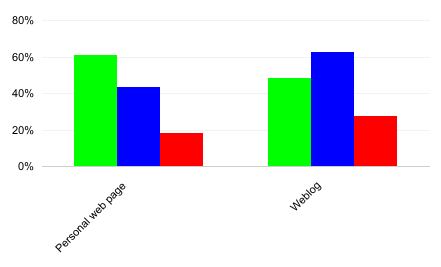
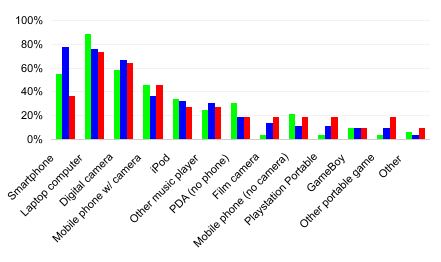
(Unless otherwise noted, the color scheme for all the charts is: green=US; blue=Europe; and red=rest of world. If you are color-blind, the order is, from left to right: US, Europe, rest of world.)
Age of Carnival readers:

We also asked about occuptaions. There were too many different occupations to cut the results by country, but overall the largest job category was mobile software company. If you add the top four categories – mobile software company, web company, operator, and consultant – they accounted for about 50% of the total.
What type of company readers work for:
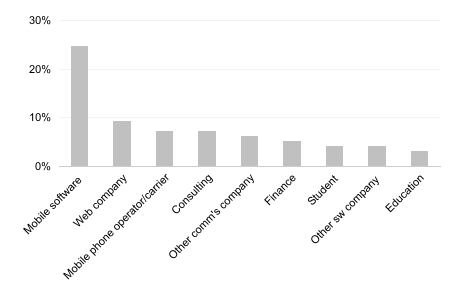
It's often said that blog authors communicate only to other blog authors. That's half true for the Carnival – about half of us have our own blogs, with the highest percentage of bloggers being in Europe.
Percent of readers having a...
To converge or not to converge? Not. I'm sure to take some flak for my interpretation of this one, but I think it's fascinating that most of us carry more than one mobile device on a regular basis. The most popular mobile device is the laptop everywhere except Europe, where the smartphone is the narrow winner.
Percent of readers carrying a particular type of device on a regular basis:
So at this point, even among the elite Mobilist readership, the smartphone is not heavily replacing the laptop for most of us. More surprising to me, the smartphone isn't at this point replacing a lot of other things either. Even if you exclude the laptop, 86% of smartphone owners carry at least one other mobile device on a regular basis.
Here are the other devices carried by smartphone owners:

More than 60% of the smartphone owners also carry a digital camera. About 60% carry an iPod or other music player. About 30% carry a game player of some sort, and 25% carry a cameraphone in addition to their smartphone.
I know there are strong advocates of convergence among the Mobilist base, and maybe it'll happen in the future. But we haven't converged yet.
By the way, 3G penetration is higher in Europe than in the rest of the world. Here's the percent of us with 3G:

What do you do with your mobile device (other than voice calls)? Short answer: a lot. The chart below shows the percent of us who use a feature more than once a day:

There were significant variations by region. In Europe (blue), texting is by far the king. In the US (green), the champs are e-mail and browsing. In the rest of world (red), games spiked quite a bit (although the sample is so small that I'm reluctant to draw any conclusions about that).
I was intrigued by the low scores for MMS, maps, and video – those are supposed to be three of the hottest growth areas for mobile data. So I took a different look at the data, comparing the percent of us who use a feature very frequently to the percent using it very infrequently. That lets you see which features are not used at all, versus which ones are used sometimes.
So, for example, about 30% of us use e-mail on our mobiles more than once a day, while about 25% almost never use it. The rest of us are somewhere in-between:
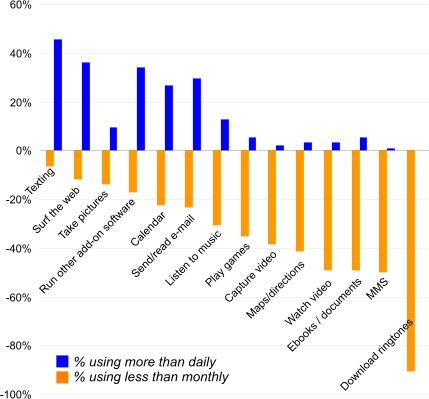
By this measure, we all hate downloading ringtones, which is very ironic since they're one of the most popular features among phone users as a whole. We also do very little picture messaging, e-book reading, and video watching. From the chart, it looks as if taking videos scored a little better, but 20% of us said our phones can't capture video. That doesn't show up in this chart, but if it did, the usage of video capture would be very low.
Which brands make us drool? Nokia. I was surprised by this one. Nokia inspired far, far more product lust than any other mobile brand we tested. I expected them to do well, but not this well. There were important differences by region, though – Nokia was less dominant in the US, and Palm was relatively weak in Europe.
I was shocked at the low scores we gave to RIM and Motorola. There are in this world Razr and Blackberry fanatics, but we haven't managed to include them in our readership.
This chart shows the percent of us giving a brand a seven or eight on a 1-8 scale, with eight being most lustworthy:

To understand the numbers better, I made a chart comparing the highest and lowest scores. The upper bar shows the percent of us giving a brand a score of 7 or 8 (the top of the scale), while the lower bar shows the percent of us who are very indifferent to a brand (a score of 1 or 2, or had no opinion of the brand at all):
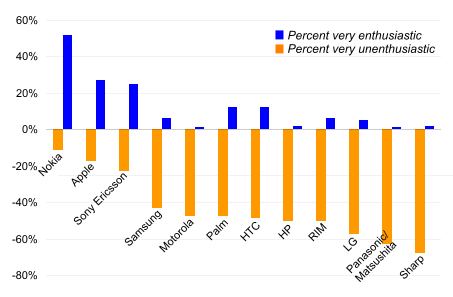
So Nokia is extremely strong, and Apple and SonyEricsson are also doing quite well (less than 20% of us were indifferent to them). Palm and HTC both had significant numbers of very enthusiastic people, although their share of indifferent people was pretty high.
I'm disappointed by the poor score we gave Sharp. Over the years, they have consistently created some of the most fascinating mobile devices. Unfortunately, most of them never make it out of Japan. And since we have virtually no Japanese readers, most of us are unaware of what Sharp's doing.
Monthly phone bill: All over the map. Usually when you ask a question like this, there's a definite curve – the responses tend to cluster in one part of the chart and then taper at either extreme. The striking thing about this chart is that there's almost no curve at all. Our phone costs are all over the map. Fifteen percent of us in Europe have monthly phone bills over $200 a month. Is this what happens when the operators don't offer flat rate data plans?
Satisfied with the Carnival. Most of us are satisfied with the Carnival, although that's to be expected since people who hate it would stop reading.
In this case, I think the written comments are more interesting than the numbers. Here they are, with groupings and a few editorial asides from me...
Happy people
Love it - great reads. I must admit I do skip some articles and only read the ones that appeal to me each week. I hope to be able to contribute later this year.
Keep up the brilliant work.
Good job everybody!
It's very good as it is.
Just keep going and keep a good balance between visionary items, technical & practical observations, entertainment stuff, usability and mobile lifestyle.
It seems quite good as it is.
Suggested features
Possibly more "Get the most out of (Insert mobile device with recently released software here) Guides"?
More information about the mobile internet - current status and future predictions.
A killer feature would be some sort of searchable catalog of past carnivals, with inclusion of their sub-links of course. [Cool! How about a meta-index of all the past Carnivals, kind of like the yearly indexes that some magazines produce? –Mike]
More photos. A forum for commentary on each article of the carnival. Creating a dialog between readers will allow more views and solutions to our wild jungle of an industry.
I find many of the articles are marketing based, this is no doubt an important area of discussion but not one which interests me much. The most interesting articles for me are those concerning everyday users and ways to make your device work best for you.
It would be cool to see how people have customised their mobiles within the community - each week have a new phone that has the best personalisation more stories about how mobile is used by the youth and generally more stories about how the people in the community use their mobile daily - my mobile day
I would like to see more articles on the mobile space in Africa, specifically South Africa where the mobile space is as advanced as any in the world, bar the far east. Certainly more advanced than the USA. Mobile technology is having a profound effect in the lives of many Africans. It is in fact helping a lot of countries bridge the technological devide.
Please more technical content. More critical. Tell me what you like/hate.
I noticed that there are only few articles in the Carnival that cover topics like PIM or alike. This is what many Smartphone-users heavily rely on...
General feedback
My original understanding was that Carnival hosts were obliged to publish every submission they received. I don't think there are a lot of low-quality posts, but there have been a few that hosts have included apparently believing that they had no say in the matter. I know this is in the host FAQ but could we clarify it somehow? [Good point, and I think we should have a discussion about this. It does vary by host. Some seem to be selective about what they link to, others (like me) link to every article that comes in during a week. My philosophy is that I don't know what info you need, so I'll let you decide. But I give much more prominent placement to the posts that I like best. –Mike]
I think the Carnival happens too frequently, which in turn lowers the quality of the writing. Most contributors are regulars and it's difficult to come up with something original every week. If I wanted to read from the same author each week, I'd probably follow his/her blog instead. I suggest to do the Carnival once per month or introduce some other measure to reduce the amount of articles/higher their quality. Maybe let the readers vote for the Top 5 articles per month.
Great summary of what is written on blogs. I would appreciate - moderated discussion as soon as carnival is released to be able to ask some questions to the authors - more insight about user experience for new services. [I like the intent behind this one, but I have a feeling that most Carnival participants would not want to move discussion of their posts off of their own blogs. Maybe I'm wrong, though. –Mike]
Often very wide range of participants. Sometimes I would have liked some focus.
Original content is what I'm looking for. There are a million aggregators but few producing thought provoking content.
Results of this survey. more questions about info or discussions, maybe some reader suggested ones.
Formatting/tone
More humour!
The themes are cute but get in the way of fast reading and comprehension. I'd also like to see a survey of posts rather than a description of submitted posts ... a little less self-promotion. Perhaps bloggers can submit their sites for weekly consideration?
Some of the authors seem to regularly write about things that are not mobile related, what's with that? Some of the Carnival hosts are too rambling, it can be hard to find the meat.
Maybe make the presentation a bit less geeky/weirdo. The first time i heard about the carnival (via a link on AAS home page), i went to the carnival's page, saw weird carnival pictures (nothing on the page that would give a hint that it was all about mobile devices) and loads of text with plenty links and inside jokes and no explanation really of what this was all about. Since i didn't have much time, I just closed the window since I couldn't quickly figure out what was happening here and the presentation just didn't appeal to me at all. It's only a few weeks later that i tried it again. This time I took the time to follow the link and eventually understood what it was all about. I'm now a regular reader but, frankly, if you wanted to do your best to scare newbies away, you couldn't do better. That said, now that i know what the carnival is, the presentation is fine to me. It's just that my first impression was one of confusion and "why the hell did AAS link to this weird thing?". Apart from that, the carnival really is a brilliant idea and it's always a joy to discover the new links every week. There's always loads of interesting things to read on various topic so keep up the good work.
[Ouch! I'm one of the guilty parties on this one. Bloggers tend to be kind of showoffs, and it's very tempting to try to find the ultimate Carnival photo or come up with a cute new Carnival-related theme. But I can see how that would be intimidating to a new reader. When I host in the future I'll try to make my write-up more accessible to newbies. Hey, how about we come up with a standard couple of lines explaining what the carnival is? Each host could put that near the top of their edition of the Carnival, to make sure new readers would know what they're seeing... –Mike]
Want more information on the survey results? Come to this address and you can analyze them for yourself.
_______
PS: Thanks to the folks at MobHappy for including my post on smartphones vs. PCs in the latest Carnival.
Subscribe to:
Posts (Atom)