(Part 1: The End is Nearer Than You Think)The most important question in mobile computing is who's going to pay for all that mobile data we're supposed to use in the next few years. The question doesn't get much discussion online, but it's at the heart of the most intense debates in mobile, including net neutrality and the wireless bandwidth "crisis."
How many users will pay for their own mobile data service? Will web companies also pay? Will the government step in? And most important, how much money are any of them willing to pay? The answers will shape the future of every company involved in mobile, and will have a profound effect on everyone who uses a mobile phone.
Here's a quick summary of my answers:
--Because of economics and user psychology, I think we're headed for a slowdown in the growth of mobile data. The unlimited, exponential growth forecasts are wrong. I believe the ultimate mobile data market will be smaller, and much more segmented, than most people expect.
--Even if I'm wrong about user demand, we're still headed for a slowdown in growth because the cellular networks can't grow fast enough to handle all the traffic being forecasted. This is due to physics and can't be changed; you could just as easily change the phases of the moon.
--Many of the proposals to "fix" the problem would probably make it far, far worse. We could end up with a cellular data network that resembles American cable TV: slow to innovate, dominated by a few players, and subject to intense politics, with users caught in the middle.
--In the future, cellular data for the majority of users will likely be metered, and the majority of people will need to be enticed into using it. That creates some excellent unaddressed opportunities for everyone from handset companies to app developers.
This is a very complicated issue, so I'm going to cover it in three posts this week:
Today's post talks about the forecasted growth of wireless data, and why I think growth won't continue the way most people are expecting. That creates some big challenges for mobile data companies, but also some fantastic opportunities.
Tomorrow I'll talk about the alternate scenario, in which mobile data growth continues at the same rate, eventually colliding with natural limits on the amount of data that can travel over a cellular network. I'll discuss how that collision drives the rhetoric about a bandwidth "crisis" and the debate about net neutrality.
In the third part, I'll discuss what it all means for the industry, and give my take on what we should do about it.
To start today's post, let's look at the predicted growth of mobile data...
The forecasts for mobile data growth are so sunny they could burn your skinEvery mobile phone will be a smartphone. Smartphones are already used by about a third of the US mobile population (
link,
link), and ownership rates are similar in parts of Europe (
link). Horace Dediu says half of US phone users will be on smartphones by the end of 2011 (
link), and non-smarthones will be virtually extinct a year later (
link).
Mobile data traffic will explode. Cisco says global mobile data traffic will increase 26X from 2010 to 2015 (
link). The growth will be driven by increased use of smartphones, and also a rise in the number of notebook PCs connected to the cellular networks. Notebook computers generate an order of magnitude more data traffic than smartphones, so even a small number of cellular notebooks drives a huge increase in traffic.
Mobile app shipments are off the chart. Apple says iOS users download 62 apps per device on average, for a total download rate of 206 apps every second (
link).
The big tech companies are focused on mobile. Many of the hottest tech companies, most recently Facebook, say their biggest focus for this year and beyond is nailing the mobile opportunity (
link).
PCs will be replaced by smartphones. A Google vice president says smartphones will render PCs irrelevant by 2013 (
link).
The growing consensus is that our current cabled, PC-centric computing world will soon be replaced by an untethered world in which everyone uses smartphones and tablets to do their computing on the go. The mobile network we all envision will be just as flexible and carefree to use as today's wired Internet, but with the added benefit that you can use it anywhere, anytime, with a wide variety of different devices.
It sounds cool, but unfortunately no one has ever asked users if we're all willing to pay for that mobile data service. I think most of us aren't.
We won't pay for all the mobile data we wantWe'll all carry smartphones, but... The forecast for mobile data growth is based in part on the assumption that in the near future most or all mobile phones will be smartphones. You can make a good case for that assumption. The price of smartphone components is continually decreasing, so at some point the parts cost a smartphone will be the same as a feature phone is today. Even if prices aren't completely equal, once they get close, it's more cost efficient for a mobile phone company to base its phones on a smartphone OS because it requires less rewriting of apps and support software for each new phone. The handset companies have an incentive to switch to smartphone hardware.
So I have no doubt that in the next couple of years most phones sold in the developed world will technically be smartphones. However, I think it's not reasonable to assume that they'll all be used as smartphones, because many users won't be willing to pay the data charges.
As I've written before (
link), when I was at Palm we did a lot of research on mobile phone users in the US and Europe, and we found that about a third of them were willing to pay extra for new mobile data features in addition to voice and texting. Some of them were more interested in entertainment, some in business communication, and some in information management. These are the people who have been buying iPhones and BlackBerries.
The other two thirds of phone users were not willing to pay extra for any new sort of mobile data. Some of them didn't have enough income, some of them just weren't interested, but they all flat-out refused to consider spending extra. The Palm surveys were conducted several years ago, but since then I have seen no evidence to suggest the basic situation has changed. On the contrary, the most recent research I've seen was done by Forrester in 2009, and it suggested the unwilling-to-pay share of the population may have dropped from 66% to about 60%. So there is movement toward more willingness to pay, but it's very gradual.
It's hard for me to believe that most of those 60% will be willing to add about $400 a year to their mobile phone bills just for the privilege of checking their e-mail on the bus or streaming songs from Pandora onto their phones. And remember, that research data is based on people in some of the richest countries in the world. It may map fairly well to other rich countries like Japan and South Korea. But in the developing world, average personal incomes can't possibly support big mobile data bills. Most people there will need to sip data through a straw rather than gulping it from a mug.
So I have a fundamental disagreement with many industry analysts about how the mobile data market will develop. A graphic would help explain...

This has a huge impact on what will happen next. The consensus view says that with only a third of the population in the US and Europe owning smartphones today, the prospects for growth are fantastic -- we can still sell to the other two thirds! And after that we'll move on to the rest of the world. The segmented view says that with a third of the population using smartphones in the US and Europe, we've already sold to most of the world's population willing to pay for big data plans. In this view, data plan growth will start to slow in the US and Europe by sometime in 2012.
The best way to check which scenario is right would be to conduct some market research on user willingness to pay for data plans. If you work in a mobile tech company, you should be doing that, urgently. For those of us without six-figure market research budgets, there are some warning signs to look for. If the segmented view is correct, we should start seeing more price sensitivity as we use up the late adopters of data plans. One sign would be price promotions on smartphones...
 AT&T's most recent iPhone advertising (link).
Another sign would be a shift in the mix toward lower-cost data plans...
 Growth in data plans, 2010 vs. 2009. In all five countries, growth is higher in mid to low-tier plans (under 50 euros / 35 pounds a month). Source: Comscore (link)
This isn't conclusive evidence, but you don't get conclusive evidence until something has already happened. There's enough evidence that we should be talking very seriously about possible saturation of the user segment willing to pay for mobile data.
What it meansSo to recap, in a few years I think the majority of phone users will have smartphones but won't necessarily pay for today's data plans. Some of the phones will connect to the web by WiFi only, while others will be on pay-as-you-go plans and won't be used for much data at all. The situation is analogous to what happened with cameraphones. Almost all of us have cameras in our phones, but most of us don't send picture messages because of the cost.
This stratification of data use will have some pretty profound impacts on the mobile market:
A change in the crisis. The first effect will be that we'd hear a lot less about the wireless bandwidth "crisis." Operators will all of a sudden feel a lot less pressure to expand their networks and get more spectrum. However, they will not be happy. Slowing data growth will probably make them miss their revenue forecasts, hurting their stock prices. Some operators may end up with excess capacity, resulting in renewed price competition in data plans, and putting more pressure on earnings. So instead of a bandwidth crisis we'll suddenly have an overcapacity crisis.
Pressure on mobile startups. Right now mobile apps are seen as a hot investment area because there's so much growth. There's a lot of venture capital available. If growth of mobile data slows, the rate of investment will slow also, as investors look for the next hot thing. This won't be a disaster for today's mobile app companies, but it would make life harder for new entrants. Also, companies that are investing on the assumption of endless growth might find themselves overextended.
Data will go a la carte. But the biggest change is that to make mobile data grow further, we'll need to entice people into using it. The challenge will be getting them to pay for little bits of data service, one app or one occasion at a time. This requires a different sort of data plan, different apps, and a different user experience on the phone...
Enticement becomes job oneA mobile data slowdown will create an enormous opportunity for smartphone companies and app developers to create a different sort of relationship with phone users. Most users will be perfectly willing to use data; they just won't want to pay for the plans. The single most important task for driving mobile data growth will be to gradually entice these people into using data a bit at a time. This creates several big business opportunities:
"Toll free" applications. Just as we enable toll-free phone numbers in which the recipient of the call pays, we should enable toll-free apps and websites in which the app or site vendor pays for the cellular data charge. I can picture several uses for this:
--Some sites or apps might be willing to pay the data charge because they earn enough from ads to cover the cost. For example, I am willing to bet that Google and Bing would both pay the data charges for a mobile search on their sites.
--Some sites or apps might be mobile supplements to paid PC web apps whose monthly service fee is large enough to cover the mobile data cost. This might apply to a music streaming service or a file storage service.
--Some third parties might be willing to cover the service fees for an app or website. For example, the movie Rio sponsored a version of Angry Birds. Picture them doing the same thing with a web app that transfers data. They don't want the users hesitating to use their app, so they will pay the data charges.
Although it's easy to talk in the abstract about toll-free data apps and websites, it will be hard to implement them. We'll need a payment clearinghouse that standardizes and manages the transfer payments between developers and mobile operators. That was done for toll-free numbers, so I assume it should be straightforward, but there's still a lot of work to do.
We'll also need a way to let the users know about toll-free apps and websites. I think this is a task for the operating system -- it should identify the toll-free apps and sites automatically and enable them on phones that don't have data plans. The operators also have work to do, because they'll need to track the data used by the toll-free apps and make sure it's not charged to the user.
It might also be good to have a top-level web domain for toll-free mobile sites. I think .up (for "unpaid") is available.
There is also an important role for government here: Don't screw this up. We need to be sure that any net neutrality regulations don't accidentally ban toll-free sites and apps. It's possible that toll-free apps and sites will end up being the main way most people access mobile data, and it's critical not to cut off that possibility. (I'll discuss net neutrality in a lot more detail in the second and third parts of this post.)
After-sales billing is critical. Mobile and web developers have already figured this out: In many cases, your best chance of making money is to give away your base product and charge for upgrades and add-ons. That business model becomes even more important in a world where most users don't have a mobile data plan. How do you gradually get people hooked on your product when they're not willing to even pay for the cost of connecting to your website?
For some developers the answer will be that you just ignore those customers (and in that case you'd better base your forecast on selling to only a third of the population). But for other developers, there will be an art in figuring out how to write a very data-efficient app or website that delivers enough value to hook a user with a data charge so low that you can pay it, at least during a trial period. That sort of art is a great opportunity for differentiation.
Micropayment is critical as well. Because developers need to experiment in incremental billing, it's critically important that they be able to easily bill customers in very small amounts. The best system for doing that looks to be Google's recently-announced In-App Payments system, which is supposed to launch this summer. Google will charge a flat 5% of your revenue no matter how small the transaction. This is a huge improvement over PayPal and Amazon FPS, both of which charge 5% plus 5 cents per transaction (in other words, they take 40% of a 25-cent transaction).
If the operators want to facilitate this sort of billing through their own infrastructure, they'll need to match Google's terms. Operators that are wise enough to enable this may be able to build tight alliances with the most innovative websites and apps, but my guess is that most operators won't be able to get comfortable with a cut as small as 5%. In that case, they should just get out of the way and let Google (and its competitors) operate.
Smartphones must entice. This is a huge opportunity for companies that make handsets and mobile operating systems. Smartphones today are designed for unlimited data plans -- here's the browser, click away; here's the app store, download something. Those apps will be ignored by a user who has a limited data plan. Instead, the phone itself will need to show the user individual functions and apps they can use for small bits of money. Want directions? That'll cost you 25 cents. Want to download an ebook? That's a buck. Folks in Europe already understand this sort of world well, because so many users there are on pay-as-you-go plans. But to most Americans it's a new concept. Get used to it. Think of mobile data like an a la carte menu in a restaurant, except that for data the options are almost infinite -- so the phone will need to learn about the user and customize the offers to his or her particular interests.
This model of infinite customization and a la carte ordering requires a fundamental redesign of the user experience of the smartphone. That means it is a huge opportunity for differentiation, maybe the biggest single opportunity in mobile computing. Apple is the leading vendor in smartphones for people with large data plans. Although Android is catching up on many countries, often it seems to be selling to the more price-sensitive end of the market (note the lower sales of paid apps on Android compared to iPhone). So it makes sense that the "enticement phone" would be built on Android. I'd like to think Google would do it, but intuitive and well-integrated user experience is not its strong suit. So maybe it'll be an Android vendor. Or maybe Nokia will do it. Or even Microsoft. Whoever gets it right first has a very good chance to be the other dominant smartphone vendor.
Or maybe Apple will do it first, and end up the leader in all smartphone price bands. It wouldn't surprise me.
What if I'm wrong?So that's what I think is going to happen: there will be a natural slowdown in the growth of mobile data as we use up the customers willing to pay for it, and the most critical task for mobile data companies will be enticing people to use their services a bit at a time. But what if I'm wrong? What if the whole population is so excited about smartphones that everyone is willing to pay for big mobile data plans? How does the world look then?
I'll cover that tomorrow, in part 2 (
link). In the meantime, please post comments and questions. This is a huge, complex issue, and I don't pretend to have it all figured out.
 Per some readers' requests---- Here's a couple of my days compressed. From the Lone Butte casino parking lot where I slept, parked among 15 others--I wake--make coffee (decaf), recruit a walking companion. We will walk the reservation fields. This spot is exactly where Phoenix ends and Indian land begins. To the left is a freeway.
 Was glad to learn that this is reclaimed water put to good use. Briefly engaged the farmer who was very proud of his crop---a tad defensive of reservation land--but we charmed him with our listening skills.
 Hay bales fascinate me---I've always wanted to stack myself a house and live cozily inside with the aroma. Once near El Centro, Ca I saw a guy do just that. These bales weigh 500 lbs each--alfafa.
 Luke digs like mad for the rabbit--but he's wasting his time.
 A Series of abandoned buildings to investigate. I love piecing together the story from the debris.
 Back at the parking lot I notice this----Am I in the mood to engage a believer?--(one of my hobbies) welllll----yes. Here goes---
  An hour later---we have "done the dance" ----a familiar whirl for me---but for this nice man from Holland ---a first. Most believers of whatever stripe rarely get to confront the "enemy"----a reverse missionary---someone trying to better the world by diminishing belief in religion. I offered those two books: LETTER TO A CHRISTIAN NATION and THE END OF FAITH--both by Sam Harris--for his consideration. To my surprise he took the former and read it overnight.
 The genteman and his wife---nice people. We parted on a friendly note. Not always possible when "doing my work".
  In the afternoon we took a short drive to witness this. The real thing still rolling.
 Saw this on a shopping trip--Of course I had to stop and challenge them.
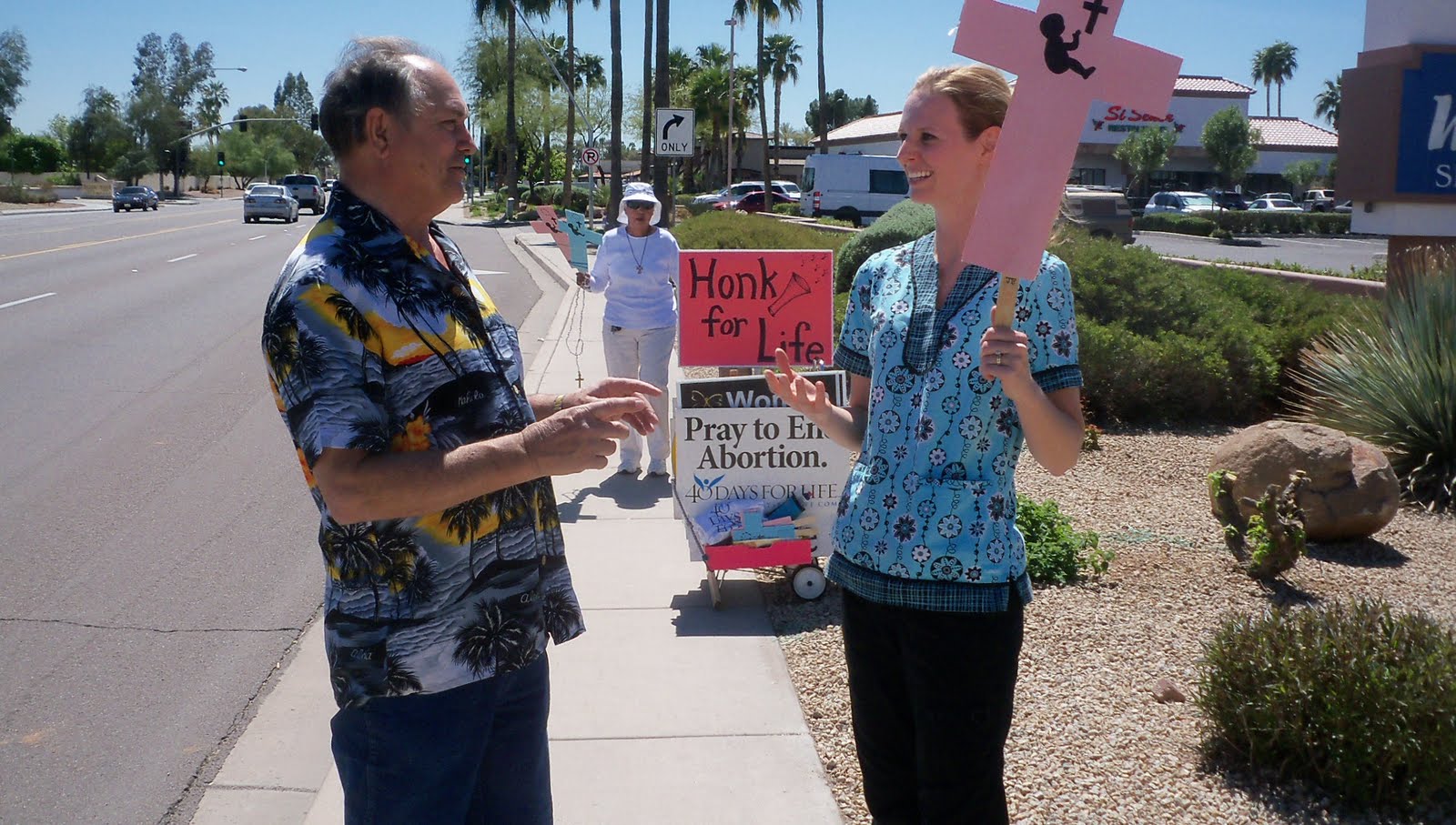 Turns out they are Catholics on a crusade. They are picketing a planned parenthood clinic---opposed to BIRTH CONTROL as well as ABORTION. Wow---do I need to say more about the damage that religion causes. Some of you may remember when I got serious into the face of these "believers":
 Chatted briefly with this guy--long enough to remind him of the harm of an overpopulated world and unwanted babies. (It was as useless as urinating on a turtle)
 It was hot---3 of us "saddled up" and headed for the cool mountains. Ahead are the infamous Superstitions.
 We stop to experience an abandoned tunnel---wonderfully cool inside.
 Beyond the old mining town of Superior, Az we arrive at the terrific campground of Oak flats---5000 ft elevation ---16 degrees cooler than Phoenix.
 I wander around--meeting my neighbors---this couple from Canada. Their rig is unique--- home- built on the body of a minivan. (17 mpg) lovely inside.
 I sense a story here!
 Sure enough---I've met another vagabond poet. Has written hundreds of poems. Shared a few with me. Has wife and kids but gets away occasionally for solitary travel and inspiration.
 He sleeps here. Stashes his stuff in cardboard boxes. A poignant reminder of the appeal of the open road experience----people will make do with scant accomodations to be "out here" adventuring.
 Chatted briefly with this guy--long enough to remind him of the harm of an overpopulated world and unwanted babies. (It was as useless as urinating on a turtle)
 It was hot---3 of us "saddled up" and headed for the cool mountains. Ahead are the infamous Superstitions.
 We stop to experience an abandoned tunnel---wonderfully cool inside.
 Beyond the old mining town of Superior, Az we arrive at the terrific campground of Oak flats---5000 ft elevation ---16 degrees cooler than Phoenix.
 I wander around--meeting my neighbors---this couple from Canada. Their rig is unique--- home- built on the body of a minivan. (17 mpg) lovely inside.
 I sense a story here!
 Sure enough---I've met another vagabond poet. Has written hundreds of poems. Shared a few with me. Has wife and kids but gets away occasionally for solitary travel and inspiration.
 He sleeps here. Stashes his stuff in cardboard boxes. A poignant reminder of the appeal of the open road experience----people will make do with scant accomodations to be "out here" adventuring.


